 Poetry School
Brandon Kilbourne has been shortlisted for this year’s Laurel Prize 2026! Read more about him and his poem ‘Blindfold Wonder’ from his collection Natural History.
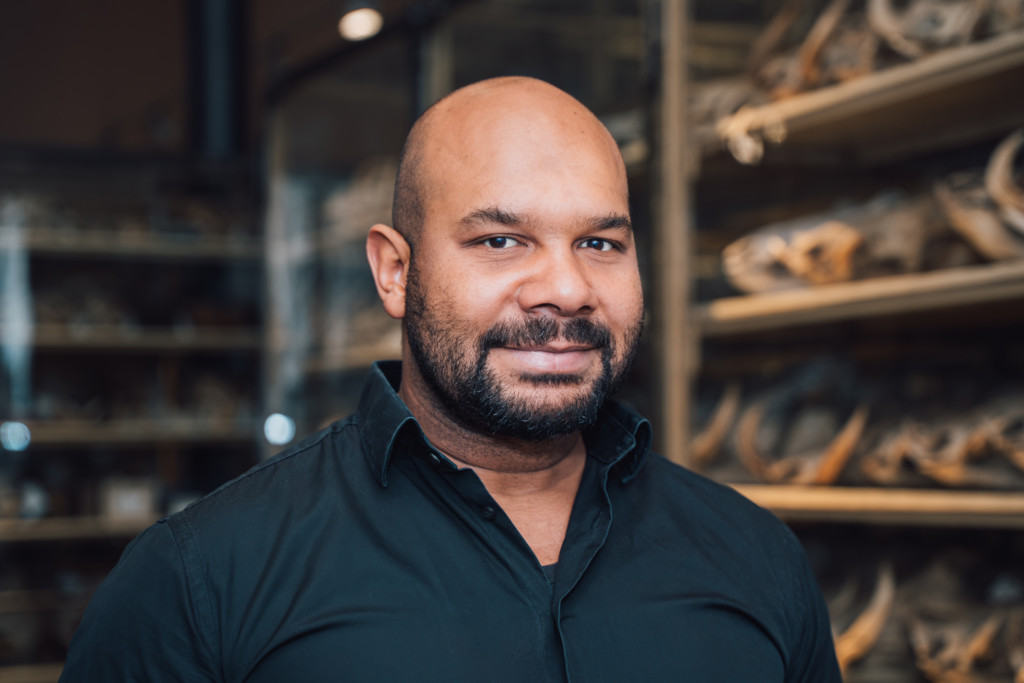
Image credit: Jamila K. Grote
About Brandon
Brandon Kilbourne has a PhD in evolutionary biology from the University of Chicago and over twenty years of experience as a research biologist at natural history museums. His poetry has appeared in The Common, Ecotone, Obsidian, Poet Lore, Tahoma Literary Review, and Terrain.org, among other publications.
On being shortlisted
Being shortlisted for the Laurel Prize is an immense honor. Coming from a non-literary background, such regard for my work fills me with joy. It also affirms that poetry, and art in general, can offer science a mirror to look back and reflect on histories long hidden and past practices long unacknowledged, an ability that science, or at least my expertise within science, lacks despite all that science can unravel about the natural world.
As human over-exploitation of the natural world threatens both non-human and human life alike through climate change and the loss of habitats and biodiversity, regard for and wonder toward nature are arguably needed now more than ever. However, it is important to remember that for all the good that can stem from regard and wonder, such appreciation is not necessarily harmless. There has been a price paid, whether direct or indirect, for both wonder toward the natural world and the knowledge that fosters much of it, and poetry can illustrate this price in terms of the people, communities, and cultures that were forced to pay it.
On ‘Blindfold Wonder’
Among the poems in Natural History, “Blindfold Wonder” is something of capstone poem for the collection. It faces a question stemming from the poems preceding it: given the grievous treatment of non-White peoples throughout the history of natural history, what then is the position of a Black person working in a museum steeped just as much in this history as it is in wonder toward the natural world?
There is no easy answer to this question, as least for someone such as me who has spent their life first admiring, and then working in, these museums. This uncertainty in the answer is reflected in the poem in differing ways. One way is the unsteady temporality in the poem—the poem jumps back and forth within my own biography, veering from the present moment set in Berlin, to my early childhood, to my experiences in grad school. Similarly, the poem shifts within world history and moves between the 1840s, 1930s, 1980s, 2000s, and today. My own history intertwines with world history in the poems, in a sign that history on the personal and the national/societal levels cannot be dissociated. In addition to the unsteady sense of time, the poem also is restless geographically and passes through North America, Europe, and Africa.
As the poem is about what it means for a Black person to work in a museum, actual work in a museum collection gives structure to the poem. Taking caliper measurements from a museum specimen, specifically the long bones of an aardvark, provides a thread tying together the meditation on one’s place and identity as it shifts across time and geography. While calipers are far, far from cutting edge technology, they are an important tool in my actual scientific research. On the other hand, while I have collected data from a range of species including mammals, (non-avian) dinosaurs, and birds, I have never actually collected data from an aardvark (though I do find the animals both odd and captivating). I cannot say why I originally chose an aardvark as a sort of anchor for the poem outside of my interest in them. However, by coincidence, or perhaps by way of my subconscious shaping the poem, the aardvark’s oddness made it a perfect choice by which to craft the ending of the poem.
I do sometimes wonder if a reader of Natural History might come away thinking I now have a dislike of natural history and its museums. Though my feelings are complicated, to say the least, my original love for museums is still part of my overall sentiments. Moreover, if I did not have love for natural history, I don’t think I would be compelled to write these poems. Of the poems in the collection, I think “Blindfold Wonder” best reflects the tension between genuine wonder and disenchantment that now characterizes my view of natural history.
This year’s Laurel Prize winner will be announced on Friday 25 September at a special event as part of BBC Contains Strong Language.
Ceremony Date: Friday 25 September 2026
Location: BBC Philharmonic Studio, MediaCity, Salford, M50 2EQ
Time: 7.00 – 8.30pm
The ceremony will feature readings and discussion with the shortlisted poets on a panel chaired by Professor of Creative Writing at Manchester Metropolitan University, Helen Mort. The event will culminate with the live announcement of this year’s winning writer. This event is free to attend but you must book your place:

The full line up for the Contains Strong Language weekend can be found here. There will also be two Laurel workshops run by the Poetry School over the weekend:
Writing the Quays with Sammy Weaver
Saturday 26 September, 11am-1pm, University of Salford
Join award-winning poet and narrowboat dweller, Sammy Weaver, for this 2-hour poetry and walking workshop exploring the Salford Quays. BOOK HERE.
As Easily as Leaves to a Tree: A Workshop in Negative Capability with David Morley
Saturday 26 September, 2pm-4pm, University of Salford
Laurel Prize Chair of Judges David Morley leads a 2 hour generative writing workshop exploring ‘negative capability’ as a practical method for writing poetry. BOOK HERE.
Add your Reply
You must be logged in to post a comment.