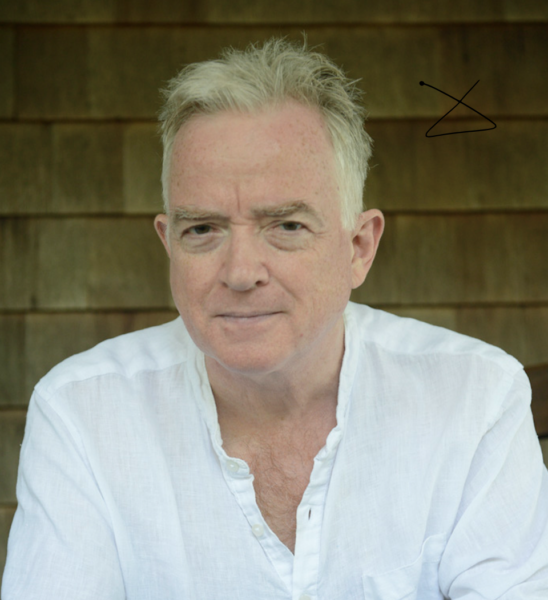
Glyn Maxwell
Glyn Maxwell is a poet, playwright, librettist, critic and teacher from Hertfordshire, England. He lived and taught in the USA between 1996 and 2006. His poetry books include How The Hell Are You (2020), Pluto (2013), Hide Now (2008) and The Breakage (1999), all of which were shortlisted for the T. S. Eliot or Forward Prizes. Next year he will publish Extinction Songs, poems for the world’s most endangered creatures; his New and Selected Poems appeared last year. His popular critical guidebook On Poetry (2012) and its comic sequel Drinks With Dead Poets (2016) set out his poetic philosophy, which continues to evolve on his Substack site Silly Games To Save The World (2023-). He taught at Princeton, Columbia, Amherst and NYU in America, at Warwick, Essex and RADA in England. Glyn has recently taken courses in psychology and in art therapy, and had a yearlong mental health placement in the NHS. He is currently writing a book about recent developments in neuroscience and their implications for poetry, politics and psychology. Along with his poetry readings, he has recently lectured in Writing and the Unconscious at the Institute of Psychoanalysis, and on W. H. Auden at the Freud Museum.
‘My poetic philosophy has evolved over the years, from a youthful inclination to canonical form, through a widening embrace of experiment, to a point where I no longer believe there is any kind of right way to make a poem. What there is is making a poem right by the lights of the creature, the singular mammalian soul with whom one is working. This may sound like a license for Anything Goes, but it’s the opposite, for the poet can only learn the depths of the craft by reading and practice, by understanding the open space around the poem, the uses of rhyme and meter – whether used or not – breaks, punctuations, vowels, consonants, pitch, tone, melody, psychology, history. I try to meet the poet in a ‘third space’ where their natural inclinations and passions meet the age-old wisdom of poetic craft. For this reason I tend to teach from work that has outlasted its makers.
I try to make – and make students make – poems with the creaturely coherence of a living thing telling its story. This allows for a great range of forms, but it also demands serious understanding of how forms actually work. I tend to say: your poetry cannot be freer than you are. What I teach initially is how to hear form. Thereafter I try to guide the poet through the development of their own work, but also their capacity fruitfully to engage with the work of others. I also seek voices within the poet that grow beyond their individual feelings, enabling work in dialogue, drama, libretto, chorus, to widen the range and raise the perspective.
While acknowledging the essential solitude of the poetic art, I try to foster – but not demand! – a communal and social atmosphere at the School, open-hearted, open-minded, open-ended, and with a sense of working in the open air, meaning open to the ages and the news of the day.’
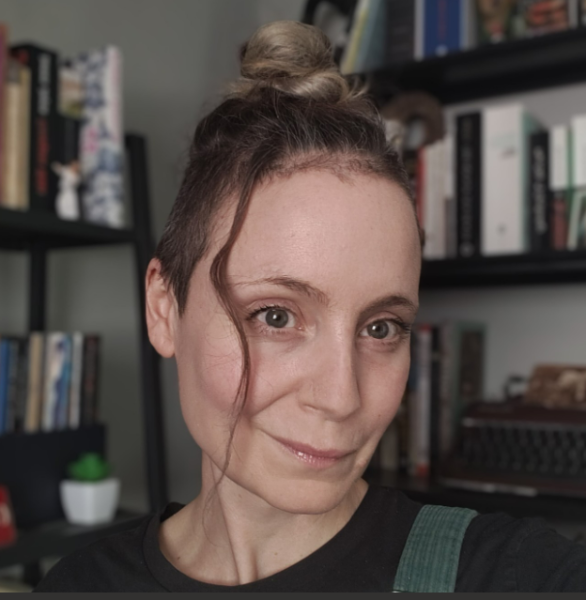
Fran Lock
Dr Fran Lock is a poet, essayist, editor, amateur medievalist, and rescue-dog parent. She is the author of numerous chapbooks and sixteen poetry collections, most notably Hyena! (Poetry Bus Press, 2023), shortlisted for the T.S. Eliot Prize 2023 and for the PEN Heaney Prize 2024. Her most recent pamphlets are Love is Stronger than Death (Culture Matters, 2025), and Hag Stone (Dare-Gale Press, 2025). Vulgar Errors/ Feral Subjects, a collection of lyric essays exploring feral subjectivity through the lens of the medieval bestiary, was published by Out-Spoken Press in 2024. Fran was the Judith E. Wilson Poetry Fellow atCambridge University 2022-2023, and is a Commissioning Editor at the radical arts and culture cooperative Culture Matters. She describes her work as prolific, versatile, and driven by a profound commitment to small-press publication.
Fran says: ‘My experience of poetry was vivid before I ever encountered a single poem on the page; my earliest and most abiding influence was and is the improvised oral performance of ceilídh and family gathering: banter, ranting; double entendre, dubious yarn, inventive insult. From a culture of rich, verbal dexterity where educational opportunity was scarce and literacy levels low, I have carried with me a love and an understanding of language not only as Literature (capital ‘L’), but as a sensory and social experience that belongs to all of us– a glorious oral/aural commons. This sense of the poem has led to a life-long affinity with the 18th century Irish poem, Caoineadh Airt Uí Laoghaire, an extemporised lament over the body of Eibhlín Dubh Ní Chonaill’s murdered husband. But it has also carried me towards the choreopoetics of Ntozake Shange and Safyia Kamaria Kinsasha.
I remain fascinated by rhythm and sound, by the way these (often unconsciously) contour and contribute to a poem’s meaning; the interplay between sound and sense, text and breath, accent and grammar. From this fascination my research and my teaching practice have sought to think across limiting page/stage binaries towards more lively and various ways of knowing the poems that capture our collective ear and intellectual attention.
My poetic appetite is omnivorous, yet I believe in knowing “the canon” keenly and critically: not as a neutral archive of excellence, but as constructed hierarchy, one that reflects and perpetuates different kinds of power. Reading into and against the canon helps us to situate contemporary lyric projects from poets such as Hanif Abdurraquib and Anthony Capildeo, who speak back to the canon and its legacies of reading in formally inventive ways.
Yet I think I am most attracted, by inclination, to the outliers – the poets and poetic movements – who exist in an ambivalent relationship to the dominant tradition or prevailing zeitgeist of their own cultural moment, whether in 14th century Europe (Thomas Hoccleve, Christine de Pizan), 1970s Belfast (Padraic Fiacc, Medbh McGuckian), or Blair’s Britain (Sean Bonney, D.S. Marriott, Verity Spott). Following the brave example of these poets, I hope my teaching creates a space in which participants can broach disagreement and explore their own positionality, while encountering work that invites them outside their comfort zone to range and play. My hope is that together we will assume the risks of failure and work towards strange, ambitious new writing.’