 Helen Ivory
As part of our Poetry Queries series, Helen Ivory discusses whether menopause can make you a better writer.
Menopause is still often seen as a taboo topic. How can writing about this life transition help women reclaim their voices?
I believe that women’s voices are repressed their whole lives in one way or another. From childhood, girls are encouraged to be nice, to use soft voices. An extreme method of control for this was the Scold’s Bridle first recorded in Scotland in 1567 as a barbaric device to control the tongues of opinionated, difficult women. Read Liz Lochhead’s brilliant poem Men Talk to see how language use has developed around the perceived differences between men’s and women’s voices.
The thesis of Sharon Blackie’s Hagitude is how women can actually be liberated by menopause, to say exactly what they want; that this often manifests as inarticulate rage after a lifetime in the metaphorical bridle. Rage is unfiltered pain, repressed for years while we just get on with what appears to have been consigned as the woman’s lot . . . the domestic chores, the caring, the being paid less than men, and the rest. All poetry writing is a way of finding form for otherwise uncontainable things – the menopause is one of those things. Every time we write it’s a victory against silence.
Many women find their bodies feel unfamiliar during perimenopause or menopause. How can those changes be used as material for poetry or creative writing?
I think the first step is to accept perimenopause and the menopause as valid subjects for poetry. They are as commonplace as water, cats, politics and giving birth. This sets into play all the writing devices we’d employ for every other subject under the sun and the moon. We can write about brain fog by perhaps showing how this looks on the page – more white space than words. The unfamiliarity we feel can be tackled with metaphor and imagery. For example, we’ll have heard of the term hot flushes before we have our first one. When we’ve actually experienced it, only then can we try to say how it feels. For example, in my poem The Change (from Constructing a Witch) I wanted to find a way to describe the hot, hot, hot/ cold, cold, cold feelings I experienced several times a night for years:
Your skin is a rubber doll plumped up with lava
that’s stumbled into a cold store at 4am.
Everything we experience as human women is material; it’s the stuff of living.
This course celebrates poets like Fiona Benson, Sharon Olds, and Lucille Clifton. What can writers learn from reading work that explores midlife and ageing?
From Fiona Benson we can learn the messiness and power of the body; the kitchen witch spells for healing and exorcism. Sharon Olds teaches us how to celebrate the glory of an ageing body and how to tell it straight. Lucille Clifton shows us how to write truth and passion with vulnerability and humour. All of these poets have their own particular lexicons which we will explore during the course.
Do you think menopause can actually make someone a better writer — more reflective, more daring, or more observant? How?
I believe so – for the reasons given in my first answer, and also because there is a greater focus on what is important going forward into the next stage of your life. In many senses you become a better editor – there is an impetus to ditch things that you’ve been carrying around unquestioningly. All of this manifests in the writing with a greater sense of urgency as if things have suddenly become brighter and more real. I am very taken by this quote from Mary Ruefle’s Pause:
If you are young and you are reading this, perhaps you will understand the gleam in the eye of any woman who is sixty, seventy, eight, or ninety: they cannot take you seriously (sorry) for you are just a girl to them, despite your babies and shoes and lovemaking and all of that. You are just a girl playing at life.
Writing about personal experiences can sometimes feel exposing. How can poets navigate writing honestly about menopause while feeling safe and empowered?
When we enter into a workshop space such as this, we should think of it as a safe space. Everybody on this course will be perimenopausal, menopausal or postmenopausal, so we will be sharing universal experiences while we write towards our own particular experiences of this transitional time. Many people write for therapeutic purposes and choose not to share it with anybody, or nobody beyond their immediate circle. There is no pressure for anybody to share the work they write on this course with anybody else, unless they choose to.
I believe that all writing has the potential for therapeutic benefit and would consider much of what I write to be therapeutic. There are methods which have helped me exorcise certain things and work out how I feel about them. For example, I used the extended metaphor of Bluebeard in Waiting for Bluebeard to write about my own experience of domestic abuse. And I have explored the witch archetype as a way to write about the menopause in Constructing a Witch. In both books I have sometimes referred to myself in the third person, which is rather liberating. I didn’t set out to write about the menopause but as I was researching my witch book, I realised that much of the negative thoughts about witches came from the fear of ageing femininity. This coincided with the perimenopause so I was able to explore my own experiences under the protective cloak of the witch.
Finally, what’s one prompt or exercise you’d give to someone who wants to start writing about their own menopause journey, whether they’re peri, menopausal, or post-menopausal?
I have found that one of the best ways to break the ice with writing when something is too big to get your head around, is collage/ cut ups. Collage introduces an element of play and chance and unlocks connections you might not have known were there. The Surrealists, and indeed, David Bowie used this technique.
Possible texts to collage with are any of the written paper material that comes with HRT packaging, sanitary products and so forth. And you can print out or copy passages from websites such as this one.
When you have your materials, set about cutting phrases and words up and rearranging them till they make a different kind of sense than they did in their original fact-driven prose. Physically moving text around is liberating and with collage, you do not start with a blank page because the material is already there. You can either stick words down on a piece of paper and fix them into place or note different juxtapositions down which appeal to you as jumping points for new and strange writing.
Helen is running her course ‘So, I’m a hag now, am I?’: Writing the Menopause Studio with us this Spring. Please note, this course is currently sold out, to get on the waiting list email [email protected].
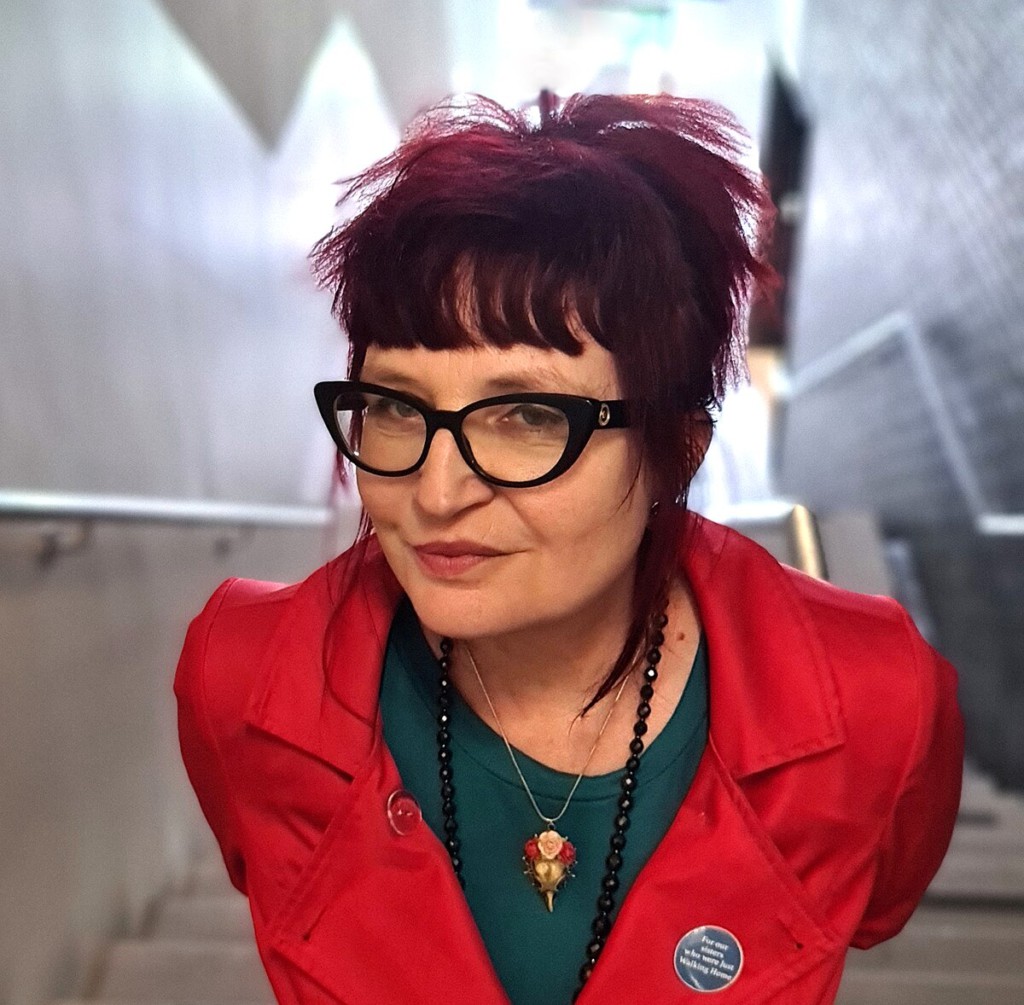
Helen Ivory is a poet and visual artist who makes shadowboxes and collage. She was awarded a Cholmondeley Award by the Society of Authors in 2024. She edits the webzine Ink Sweat and Tears and has led workshops in a largely adult education setting for around twenty-five years. She teaches for the National Centre for Writing Academy and Arvon. A poem from her surrealist chapbook Maps of the Abandoned City (SurVision 2019) is one of the Poems on the Underground. She has work translated into Polish, Ukrainian, Croatian, Spanish, and Greek as part of the Versopolis European poetry platform. Her Wunderkammer: New and Selected Poems appeared from MadHat in the US in 2023. Constructing a Witch (October 2024), her sixth collection with Bloodaxe Books, is a PBS Winter Recommendation and explores the monstering and scapegoating of women, the fear of ageing femininity, cultural representations of the witch as an outsider, female power and disempowerment, the menopause, and how the female body has been used and misunderstood for centuries. In Summer 2025, Constructing a Witch was translated into Greek by Nikolas Koutsodontis and published in Greece by Thraka.
Add your Reply
You must be logged in to post a comment.