 kit griffiths
In this series, we interview our tutors about poetry and its place in their world. These interviews will cover creative writing tips, excelling in a poetry workshop, building a literary career, and finding your poetic voice. Here’s Kit Griffiths on how to write about your family.
When you start writing about your family, what’s the first step? Do you start with a memory, a character, a feeling, or something else?
Most of my poems happen because a memory or moment catches the light while I’m going about my day. Those are my favourite poems. As for the grand slog of conveying whole characters, events and histories, I try not to loot my past without investing in my present. If I’m thinking of writing about someone at large, I give them a call – or a text or a meme if they’re tricky – I don’t talk to them about poetry but just try to bring something positive to that relative and our relationship, without needing anything back. Then I read some inspirational poetry; take a workshop, or a course, or ask the librarians for new recommendations at the NPL, and find my safe space to write towards healing. When I’m not up to contacting family, if I’m in pain then I need connection, I b-line for workshops rather than writing alone.
How do you decide which stories, moments, or relationships from your family make it into a poem and which ones to leave out?
So many moments! So many stories. To help me out with the deluge of possibility, I no longer take notes every time I have an idea or a memory – I allow the pressing ones to rise the surface again and again, until I’m a little obsessed with the moment and know it needs to be written down. Of course sometimes you just have a whole poem coming out and go with it, but I don’t obsess over recording every thought-scrap in my notebook anymore. And, particularly when writing about events from childhood, I ask myself, “Is there love in it?” If I’m going to spend hours of my one and only life in a headspace – drafting, polishing and sharing the work – I need there to be some love in it, so it feeds me instead of depleting me.
Many writers focus on birth family, but what about chosen family or queered family? How can you approach writing about the families we build for ourselves?
The way I see it, my chosen family are spoiled. I’m eternally showering them with praise and allowing all manner of nonsense, when a bio-family member can make one comment and I’m ready to cut them out. I used to be anyway. It’s entirely logical, with all that PTSD and old betrayals unresolved, there’s mad pressure on the family we were raised by (whether they’re bio or not). But I actually think that’s what makes the poetry strong – that’s what makes it essential – and that’s why ‘The Family’ (with capitals) gets so much airtime. The deal for my chosen family is, I love you unconditionally with ease; sorry there are fewer poems. My friends get the worst deal/least poetry, because lovers inspire obsession (just like parents – let’s not overthink that one) so I write plenty of erotic/romantic poetry, as a breath of fresh air from the family stuff. I plan to approach and build a body of work for my friends, once the urgent work on family, lovers, and strangers (!) is out there in the public doing its good. My friends are very patient, because they’re perfect.
Family dynamics can be complicated: love, conflict, disappointment. What techniques help you capture those complexities on the page without over-explaining, or over-exposing yourself?
I never worry about over-exposing myself, but I do have to worry about exposing others. Obviously the angry little justice voice in my brain says, “Well if you had to suffer it then you get to write it!” but the voice is a part of my shadow side – it’s welcome to the work-party, but doesn’t often get final say. I’m actually just finishing my full collection about my family, and I’ve decided that every person mentioned will get to see the whole thing, and tell me if they want something taken out. My hope is that, with the scope of the work and the amount of love in it, they will understand that the pain has its place. If they are just too ashamed of it being in public, I’ll prioritise their shame – and our relationship – over the publication and career. Until they’re dead and then I’ll have a wicked time.
A lot of writers worry about upsetting relatives when they write honestly. How can you write truthfully about your family while still being sensitive to their feelings?
I think it’s good practice to accept that we hurt each other. I told my aunty I blamed her for my uncle’s death – what the hell was I thinking?! So, messing up is part of honest, authentic relationships, because sometimes we don’t think well when we’re feeling so much, but there’s a difference between careless or thoughtless messing up, and the considered process of choosing to edit and publish a poem that we know is hurtful. Write the poem by all means – write anything you need to write – feel all the things you need to feel – but do question yourself when you come to put your work into the world. Ask yourself why you want to publish – for the sake of good art? For truth? For justice? For others who are hurt to feel seen? Those are all legitimate things, and if you decide they’re just as important as your relationships, then my recommendation is to stand by that decision and give your family the courtesy of warning and explanation: “I love you. I’m grateful for you. I also need to share this work.” If you don’t love them or feel any gratitude for them, then it might be that you’re using poetry instead of therapy, which I think is common and unsustainable – we need both things, and more – we need all manner of healing.
How can small, vivid details: objects, gestures, sayings, bring a family to life in a poem?
Trust the tiny. I often think my poem is going to hold lots of tiny details – a treasure trove of noticings for maximum beauty and profundity – then the best poems come out with just one thing, or two that make an unexpected pair. So I’d say don’t try to make up for size with quantity – trust the tiny thing to do its job without putting noise or over-explanation around it.
I’m a multimedia artist-filmmaker-poet, and the piece in my Delusions of Grandma solo show that made the most people cry (!) was a very simple sketch of a man’s torso – a few lines to show shoulders, arms, one hand in a pocket – with a tiny bright red painting of plum tomatoes where his heart should be, a faint pencil outline of a tin around them, and the title, ‘Dad stocks tinned tomatoes now that he knows I like them.’ Everyone gets the magnitude, of how he didn’t know before but now he thinks about me when I’m not even there, when he’s shopping in advance of my visit. Find your tiny detail and pare it right back. Test on fresh readers that you haven’t gone too far and it still makes sense.
Finally, do you have a prompt or exercise you’d recommend to help writers start exploring their own family narratives, whether birth or chosen?
Yes. This one is inspired by Elizabeth Bishop’s ‘The Filling Station’ so give that a read first. And then… Write about a relative, or a family scene, from the perspective of the ‘low-stakes stranger’.
Consider facial features, the way they walk/move, clothing, accessories, objects, music, food, drink, places you can picture them in with great detail.
If describing a scene that you are/were in, then you must use the third person to refer to yourself – e.g. “He told his daughter he’d put her school report in the bin. He said it was shining too brightly.” This popped into my head, watching my father and myself.
You’re allowed to be a judgmental stranger, but you cannot have any inside information, be it emotional truth or events other than the one you’ve chosen to witness. Even if judgemental, can you also be endeared?
This exercise is one in disconnection, which makes it one of the safer ones to do alone! Can you momentarily disconnect yourself from the existing narrative, to observe an isolated event. What do you see? What might you think of someone if your mind and heart weren’t already made up?
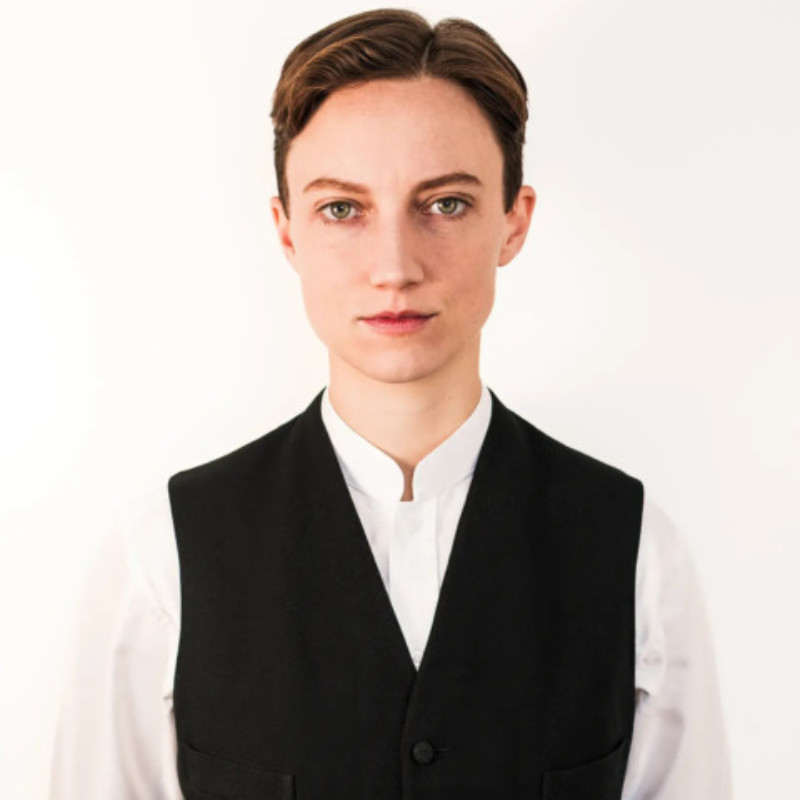
Kit Griffiths is a transmedia artist with fourteen years’ practice centring intimacy. Kit is a Southbank Centre New Poets’ Collective 2023/24 alumnus; winner of Third Prize in the Poetry Wales annual international competition 2023; had their first pamphlet Old Poverty published by Earthbound Press in 2020 and is currently working on their first full collection, Delusions of Grandma, mentored by Caroline Bird with DYCP funding from Arts Council England.
Kit has a BA in English from the University of Cambridge. As well as giving private 1-to-1 poetry tuition, Kit has hosted poetry workshops with Arts Council England, University of Vechta Germany, University of Savonia Finland, Reclaim the Frame London, Broadstairs Kent College, Margate Pride, and The Poetry School. Kit has exhibited at The Turner Contemporary Margate, Art Basel Hong Kong, Queer ART(ists) Now London, and The Beaney Museum Canterbury among others, and had solo shows at Quench Gallery Margate and Kavel Rafferty Margate. Awards include winner of ‘IDEA’ OFF-WEST END AWARD for Sex, Sex, Men, Men with Pecs Drag Kings, and Winner of Best Short Documentary at Toronto Alt-Film Festival. Live performance venues include Tate Modern, Tate Britain, The Royal Academy, Southbank Centre and Soho Theatre.
Kit will be running Delusions of Grandma: Rewriting the Family Narrative with us in the new year, starting on Thursday 22 January. To find out more and to book your place please visit the course page here.
Add your Reply
You must be logged in to post a comment.