 Elizabeth Parker
As Valentine’s Day draws closer, our tutor Elizabeth Parker, who will be teaching the upcoming course This Modern Love recommends her top five love poems you should be reading right now.

Image by Turgay Koca
A contemporary love poem
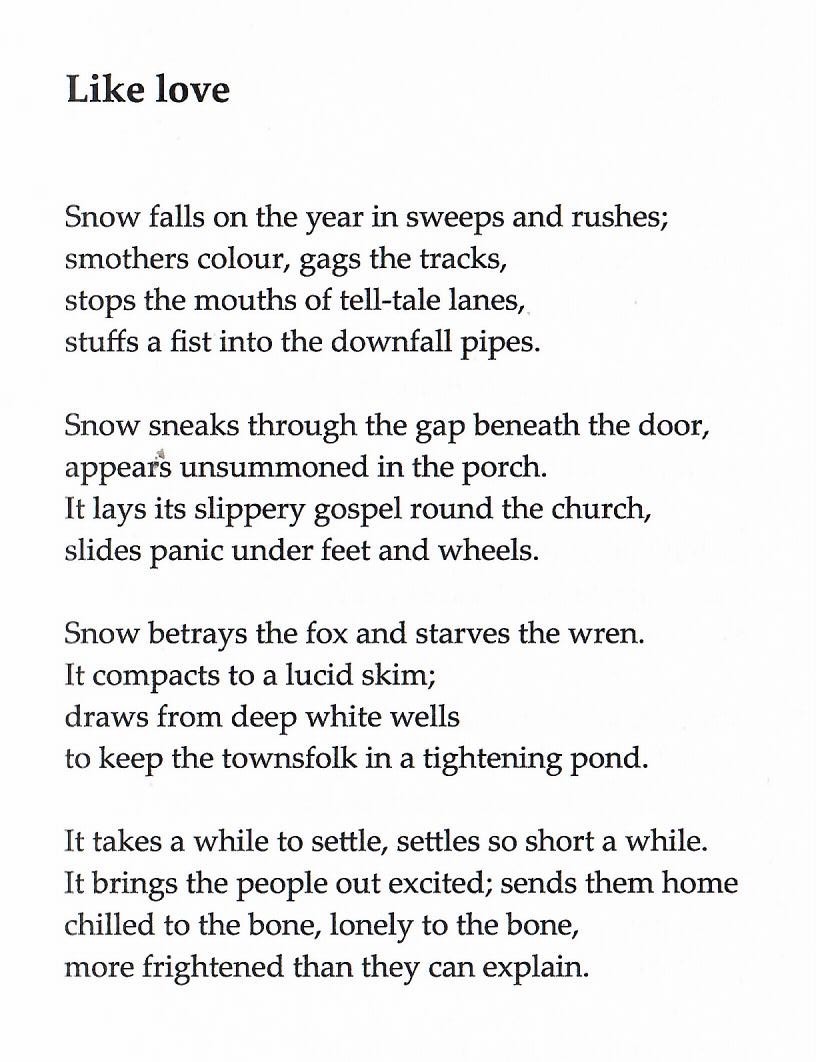
‘Like Love’ by Jo Bell
The hardworking two-word title of this poem frames a thrilling depiction of snow as an extended simile for the glories and dangers of love.
Always, in Bell’s work, we are rewarded with the quality of imagery we hunger for when reading poetry—imagery so fresh, so packed with meaning that we marvel at it, feeling the poet has worded something that has always been there, awaiting definition. Bell’s metaphors often center on verb choice and tactile detail. Here, snow (and love) ‘gags the tracks’, snow (and love) ‘lays its slippery gospel’.
Bell’s collection Kith (in which this poem is featured) is a gold standard for me and I recommend it to poetry lovers, aspiring and published poets alike.
Read the full poem here: Like Love
A love poem that has come from a place of adversity
‘So many requests, always, from a lover!..’ by Anna Akhmatova
In the acclaimed translation by D.M. Thomas, the opening image of the poem is a speaker standing on a frozen lake looking at the unmoving water beneath. From this precarious standpoint—’And I’ll stand – God help me! –on this ice,’— the speaker contemplates love and its legacies through imagery ranging from icescape to letters, textbooks, desklids.
The workings of this poem continue to fascinate me as I try to understand how Akhmatova has created a poem in which every detail and image resonates.
The opening line is staggering in its scope and the influence it has on every line that follows, as the reader is aware that the speaker is experiencing the ensuing thoughts and emotions from the most dangerous, risky standpoint.
Thomas’s acclaimed translations give us a strong sense of Akhmatova’s celebrated employment of traditional forms, rhyme and meter and we catch something of the chiming she achieves through alliteration and assonance. Shifting from more iambic lines to lines in which the words used to depict the fragile and transient— ‘light and brittle’, ‘letters’—create texture and quicken the meter, this is poetic technique used to its full force.
The envelope rhyme closing the final stanza sounds the finality, the absolute conviction, of the poem’s bold closing message—‘When they’ve read my grievous story,…/If I can’t have love, if I can’t find peace/ Give me bitter glory’—as we continue to feel an intimacy with a speaker so compelling you hear their voice long after leaving the page.
Read the full poem here: So many requests, always, from a lover!..
A love poem from the literary canon
‘Jenny Kiss’d Me’ by Leigh Hunt
In this blaze of a poem, Hunt asserts the power of poetry through using poetry at its most skilful to mark a single moment in a life—a mark of eight lines that has lasted nearly two hundred years.
Here is a poem expertly measured to convey the speaker’s exhilarated declaration that life’s hardships are, and will be, matched by, balanced out by, possibly even outweighed by, the glory of the moment he is kissed by Jenny.
Bring it. I’ll match it. This, for me, is the message of the poem. In the lines ‘Jenny kiss’d me when we met,/ Jumping from the chair she sat in;/ Time, you thief, who love to get/ Sweets into your list, put that in:’ Time’s actions (capitalised, personified—there’s no shying away here) are matched with Jenny’s action syllable for syllable, simple three letter verb for simple three letter verb, sound for sound—the rhyming of penultimate words achieving the effect of full rhyme while allowing the poet to repeat end words.
The rhyming of ‘miss’d’ with ‘kiss’d’ in the lines ‘Say that health and wealth have miss’d me, / Say I’m growing old, but add / Jenny kiss’d me’ is particularly ingenious, with the matching of sounds helping to convey the speaker’s conviction that wealth and health passing him by is balanced out by Jenny hitting the target, in kissing him.
The poem begins and ends with ‘Jenny kiss’d me’. Between, a compact summation of life’s hardships fails to overpower the joy of a poem. The elation conveyed here, expressed partly through the scattering, throughout, of high vowel sounds, creating an overall brightness of pitch, will leave readers feeling strengthened and affirmed in their belief in the power of art.
Read the full poem here: Jenny Kiss’d Me
A love poem I have read recently, for the first time
‘Love’s Bonfire’ by Tom Paulin
As Hunt declares the lasting significance of a moment, Paulin’s speaker believes that the moment he re-visits in the poem may have been forgotten by his lover.
As with Akhmatova, the speaker and his lover are in a dangerous situation. This is conveyed early in the poem through the naming, in brackets, of The Troubles and, later, reference to an arranged marriage. Though the walk is in the past, the directness of the narrative, with its feeling of spontaneity—the speaker interrupting themselves to add details (expressed through the use of hyphens), their use of ‘So’ to pick up a thread, resume their telling—takes the reader close to the lovers, to their walk and the dangers that surround them.
Line length is used create various effects. The lines are predominantly mid-length and shorter, conveying the hesitancy of the lovers, the slowness of their walk. Lengthier lines jut from the main body of the poem, such as line four: ‘my love and I were walking in secret along a rough track’. This line visually and rhythmically gives the reader the sense of the lovers setting out, the long prospect of the walk and the track, while also, with the line jutting into white space, something of the lovers’ vulnerability. It also gives the feel of that interconnectivity of motion, emotion and physical environment we get when walking—a feeling that would be lost were the line broken.
Another longer line conveys the speaker’s excitement and nerves: ‘…at this brave new so-tender thing between us’. With no commas, the breathless piling on of adjectives expresses the newness of the feeling, as the speaker attempts to define it. Again, there is a thrilling sense of spontaneity.
While Akhmatova’s dominant image is the brittle ice on which her speaker stands, the central image here is the embers of a bonfire the lovers discover, one emotional turning point of the poem being speaker’s realization, as he watches his lover stoke the embers, of how different they are to each other: ‘I saw then I recall/ that we were quite different people – you were active’
As Bell’s descriptions of snow take the reader on an exploration of the intricacies of love, so this speaker’s telling of the walk and the bonfire is vivid with implications about their relationship. The interplay of the image of their love being ‘soft and tiny as a lark’s egg’ and the image of the remnants of the bonfire— ‘From under the soft white ash/ the red embers started’—both images of brittle surfaces beneath which life and heat stir—continues in my thoughts.
The final lines of this poem are so intriguing they sent me right back to the start. The speaker anticipates that, were he to mention the walk to his lover, she would respond with the Latin ‘veteris vestigia flammae’ (‘the traces of an old flame’). The questions these lines raise about their relationship had me re-treading the path of the poem over and over, savouring details, noticing techniques and the expertise of this prestigious poet as I did so.
Read the full poem here: Love’s Bonfire
A love poem that is always makes me smile
‘A Subaltern’s Love Song’ by John Betjeman
Betjeman’s exhilarating ride of poem ‘A Subaltern’s Love Song’ was my late dad’s favourite. It is a poem I turn to time after time for the uplift, the rush it gives me with its light, energy and velocity. Like Hunt’s, this is a poem that will burst into whatever mood or day you’re having and leave you energized.
Metrical richness creates a sense of motion unsurpassed by any other poem I’ve read. With four stresses per line throughout, in the opening stanzas these work to both emphasize the loved one’s name and, with the use of anapests and iambs, express the light-footed skips and hard landings of the tennis game.
The pacey meter continues as the speaker takes us on a tour of the fast-paced lifestyle of ‘Miss Joan Hunter Dunn’, the subject of the poem, from tennis game to dance.
Read this poem you will be transported by it. Its after-images and sounds will linger and you will continue to escape into that world of ‘Aldershot sun’, ‘Surrey twilight’, ‘the lights in the hall’, ‘scents of conifers, sound of the bath’.
Read the full poem here: A Subaltern’s Love Song
Elizabeth is running her Onine Zoom course This Modern Love with us, starting Saturday 14 February 2026. To find out more and to book your place please visit this page.

Elizabeth Parker was born in London and grew up in Pygmy Pinetum Garden Nurseries, a garden centre in The Forest of Dean. She lives in Bristol with her partner and two sons. She was a secondary school English teacher for eight years and is writing two novels based on her experiences teaching Shakespeare to teenagers.
Elizabeth’s first full collection, In Her Shambles, was published by Seren Books in April 2018 and her second collection, Cormorant, was published by Seren this February. She is a founding member of Bristol poetry quartet The Spoke, who perform their work at festivals and events. She is also co-host of monthly Bristol poetry event Under The Red Guitar.
Elizabeth is currently experimenting with poetic forms as she works on a long poem about her wonderful father, who has late-stage dementia, and a collection about the life and sudden loss of her sister, the playwright and glorious human being Helen K Parker. Her cormorants continue, as she has just begun to draft a poem titled ‘Helen As Cormorant’.
Add your Reply
You must be logged in to post a comment.