 Catherine-Esther Cowie
Welcome to our Writers’ Notes for the 2025 T.S. Eliot Prize shortlist. These are educational resources for poets looking to develop their practice and learn from some of contemporary poetry’s most exciting and accomplished voices. Here’s Catherine-Esther Cowie on her collection Heirloom.
A Break from Words
During the height of Covid-19, I had just finished my MFA and completed an early draft of Heirloom. Emotionally, I was exhausted from juggling school and work, as well as confused and fearful about the pandemic. Poetry, which I often turned to for refuge, felt like this pool of painful emotions that I dreaded wading through.
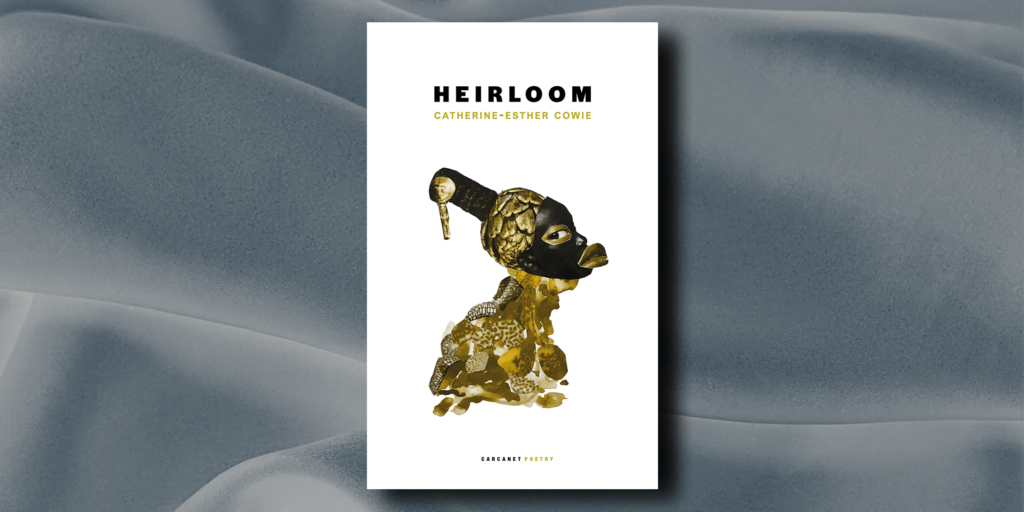
I wanted distraction. An escape. I took a collage class online and fell in love with playing with paper, paint and glue. For a few hours each day as I quarantined in my apartment away from family and friends, I became a child again.
With visual art, I wasn’t interested in meaning but expression and experimentation. I wanted a break from words, from being in my head. Collage provided a more physical experience – touching different textures of paper, watching India ink move through water, listening to the satisfying rip, rip, rip of construction paper. Cutting up ads and images from magazines and fitting disparate images together like puzzle pieces.
When I returned to writing, I felt refreshed, ready to tackle the craft issues as well as the emotional excavation that Heirloom demanded.
Longer Pauses
Following that year, I started to take longer breaks from working on writing projects. Yes, to a certain extent, to direct some of my energies towards developing this new medium but also to refresh my creative storehouse.
I write nonstop during the year for six to eight months or until I have a full head. A full head is when I can’t seem to make headway on multiple writing projects or individual pieces. Often, I can’t critically process feedback from my peers. My head is full of ideas… words. I am unsure how to prioritise various writing projects. I feel anxious. Everything seems jumbled and tangled together.
I know then that it is time to take a break. To turn away from writing. To work on a 1000-piece puzzle, to go for long walks, to work on visual art or go to a concert. To spend more time with family and friends.
Most often these longer pauses from writing happen in the middle of the summer or closer to the end of the year and I take advantage of those seasons – joining in holiday festivities, exploring parts of the city I haven’t seen, reflecting and setting creative goals for the new year.
On Tackling Stagnation
Inspiration
Reading other poets or fiction writers often inspires me to write a new poem, to experiment with a craft technique or explore writing about a particular theme. It might foster new approaches to a poem that I am struggling to revise. Writers that have inspired me while writing Heirloom are Natalie Diaz’s first collection, When My Brother Was an Aztec – her use of form and how she weaves Spanish into her work.
Brigit Pegren Kelly’s ‘Song’ was a poem I reread often for her exploration of violence and its lasting effects on the perpetrators, ‘…This song/Is sweet. It is sweet. The heart dies of this sweetness.’
I also have a collection of Paul Celan’s poems that I turned to during the final months of revising Heirloom. He writes bitterness brilliantly. In terms of craft, I studied his poems ‘Psalm’, ‘Zurich, Stork Inn’, ‘Tenebrae’ and ‘Black Fugue’ for how he used repetition/anaphora.
Soundscape and Emotional Access
Sometimes when I begin to work on a poem or a short story, I listen for a sound, a rhythm, a tone before I fully submerge myself into a piece. Music can sometimes help me to find that poem or short story’s soundscape. Other times, music helps me to connect with my emotional landscape especially if I am stuck and can’t seem to make progress on a poem.
Community Conversations
Whether it’s feedback on a poem or simply talking about poetry or the themes I am exploring in my work, conversations with other writers has helped immensely in sparking ideas on how to approach a writing project or how to revise a poem or new ways of writing about a theme.
Listen
A poet I met at a workshop during my early writing years once advised me to listen to the poem. I had no idea what they meant but I have come to understand it as quieting the noise in my frontal lobe and tapping into my intuition. Not forcing the poem to go in a direction that I initially thought it should go in… Sometimes that would involve not looking at the poem for a week or two or for months. Sometimes that means identifying consciously the heart of the poem and orienting from there to move the poem forward. Sometimes it means listening to the poem for places where it feels forced or emotionally dishonest.
A Moment
And sometimes, I am not ready for a poem. I believe that I might find a poem stagnant because it represents a moment in time – where I was emotionally and technically. Perhaps, the poem is complete? It may not be as strong as my current writing, but it’s done its work. And there are poems that I am unable to advance because I am not ready for them emotionally or technically. Perhaps a year from now, or ten or twenty, I will return to this poem or poems with the emotional clarity and technical skill required.
The Poetry School and T.S. Eliot Foundation have long collaborated on celebrating the T.S. Eliot Prize shortlist, highlighting this major fixture in the poetry calendar as a fantastic way into the art form and an opportunity to learn from poets at the top of their craft. This year we have a series of Writers’ Notes from the shortlisted poets.
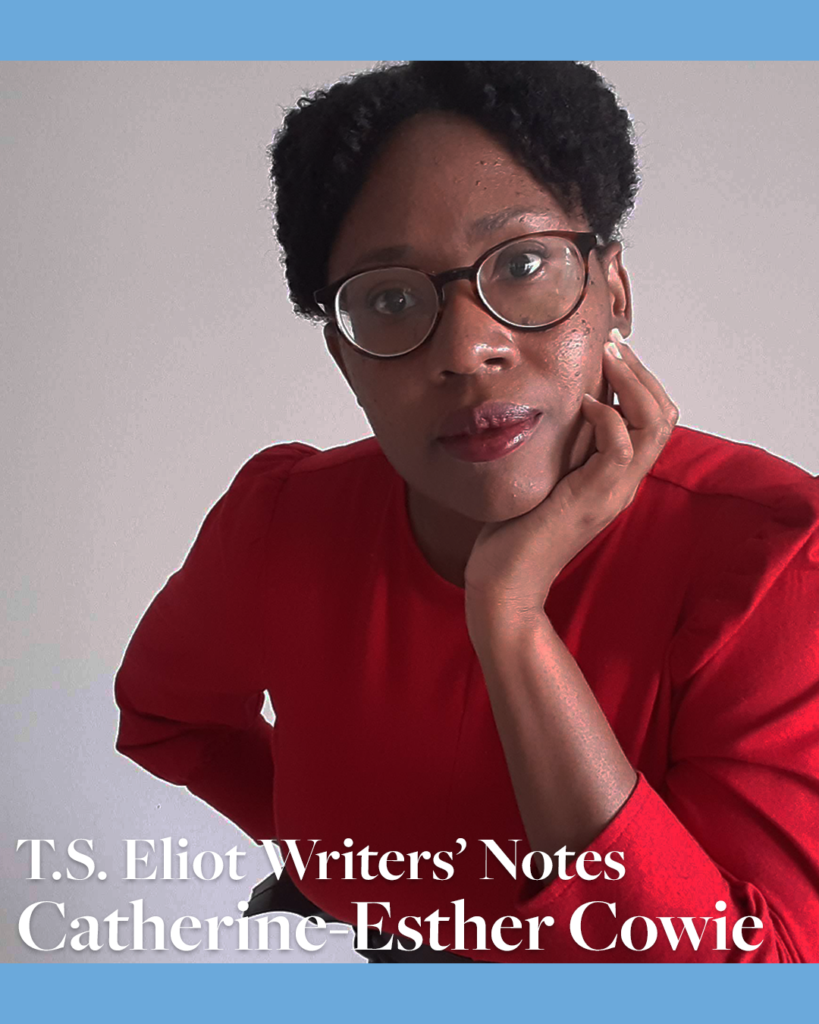
Catherine-Esther Cowie was born in St. Lucia to a Trinidadian father and a St. Lucian mother. She migrated with her family to Canada and then to the USA. Her debut poetry collection is Heirloom (Carcanet Press, 2025) which was shortlisted for a Forward Poetry Prize. Her poems have been published in PN Review, Prairie Schooner, West Branch Journal, The Common, SWWIM, Rhino Poetry and others. Cowie is a Callaloo Creative Writing Workshop fellow. She lives in Illinois, USA.
Add your Reply
You must be logged in to post a comment.