 Karen McCarthy Woolf
Welcome to our Forward Prizes 2026 ‘How I Did It’ series. This year we asked poets shortlisted for the Jerwood Prize for Best Collection to write about the inspiration behind one of the poems from their book.
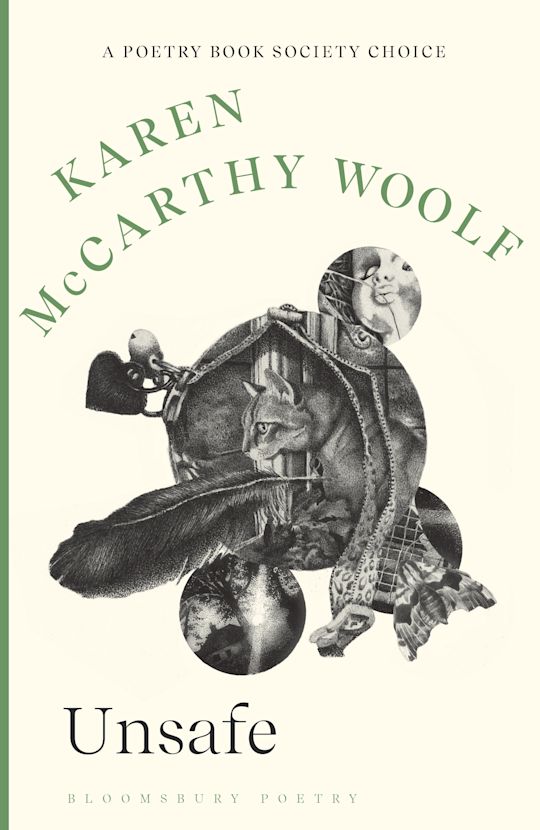
Here’s Karen McCarthy Woolf on what inspired her to write the extract from page 44 of her poetry book Unsafe.
Zoning in
Zoning in on one poem felt like a difficult ask because Unsafe is a single, interconnected piece, surrounded by a prologue and epilogue, which is a disrupted glosa, a 16th century Spanish intertextual form which here riffs off a quatrain from John Clare.
Clare was one of many influences and inspirations through which I think about how the enclosures he resisted in the 19th century are still going on today; how these enclosures are actual and algorithmic; how we confine humans and animals for profit; and how this connects to land grab, extractive capitalism and its violent impacts on nature and climate.
A Moment
I chose this section because I think it speaks to Unsafe’s overriding themes around precarity, and also because it’s a single, self-contained moment; a moment which also forms the centre of an animated triptych I made in collaboration with the Poetry Society and a Venezuelan collective MECHA, where we see a uniformed version of Clark Gable as Rhett Butler in Gone With the Wind, or at least we see his moustache.
In the animation Gable’s moustache actually becomes synecdochic for the whole of the South, as does the ‘gleaming, multi-columned Southern mansion’ of the poem, and by extension, what this means for anyone other than Vivien Leigh.
Road Trip
The excerpt takes place on a road trip from a writing residency in Ucross, Wyoming, to Denver, Colorado via Nebraska and Pine Ridge, in South Dakota, which is the ancestral home of the Lakota and the legendary Chief Red Cloud. It’s a profoundly beautiful and emotionally resonant landscape, and also the tribal nation to which the poet Layli Longsoldier belongs, whose book Whereas was a major influence.
Here I’m focusing on a particular moment, specifically getting pulled over by local cops in Nebraska, and how this experience is a stark reminder of the ways in which Black people are so disproportionately policed, surveilled and killed.
There’s trauma and also strangeness. A madness even, because when you really think about it, there’s no ideology more illogical than racism. It’s a ridiculous, viral concept.
This excerpt is a prose poem, a form I used because the whole experience felt very cinematic, not only in its references, but also because the ‘road trip’ is such an iconic Hollywood trope.
There’s a dreamlike quality to much of the book, even though I didn’t intend it as such. For me, the instance when a poem yields its surprise is mystical, and it’s the compositional moment I most enjoy, when a new feeling or concept is almost inexplicably birthed.
Images as Punctuation
I’ve included one of the photos from the book; photos taken on my phone. Photography is a big part of my process, and I’m very interested in the idea that process can be explicit within the work.
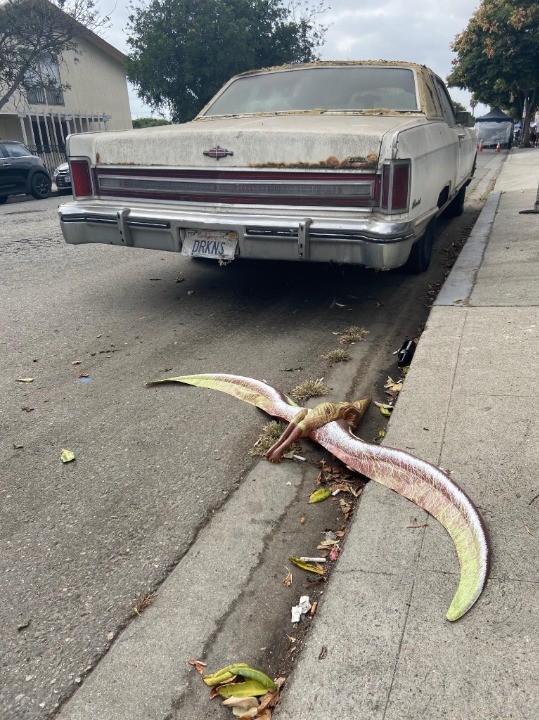
The phone image is probably now more ubiquitous than the semi-colon (although I use a few here!); it’s part of our vernacular. I like to use the images not as illustration, but more as a form of punctuation, and as a way to shift pace, tone and idea.
So while the image of a pterodactyl and a semi-abandoned gas guzzling vehicle speaks to deep time, the excerpt is focused on the contemporary moment.
Economic Extremities
Juxtaposition is an important structural feature, and one which characterises the zuihitsu, a classical Japanese form I use as a way to manage and control a lot of diverse (if thematically linked) material.
Living in LA, where I was based at the Promise Institute for Human Rights at UCLA, gave me access to the law and statutes which were used to colonise the continent. LA is so emblematic of the economic extremities in the US, with its 25 dollar loaves of gluten-free bread and shanty towns on the streets of Venice Beach; while Pine Ridge is one of the lowest per capita income regions in the country.
Around this time I also had a commission from 1418 NOW to write about the history of barbed wire and how it was used to colonise the American West. It’s not a word I use very often in the book, but it’s there, as static weapon and technical innovation.
Contradictions
Ruth Gilmore Wilson’s writings on carceral geography, the prison industrial complex and abolition were also very important in terms of framing the macropolitical ideas, which I contrast with lots of small quotidian details, like why we get tattoos, feel scared in the woods, get stopped by traffic police, or dress up our cats in sweatshirts and sunglasses.
There are many other layers, even though what happens here is narrative. It’s a vignette, seemingly innocuous; a mood I establish through that bizarre, jokey tone which the younger police officer adopts. But there’s a sinister undertone.
I’m attracted to subtext, and how what we say and do can be so converse and the way in which poetry, with all its possibilities for producing meaning through shape and sound, is an ideal conduit for such contradictions to play out.
About Karen
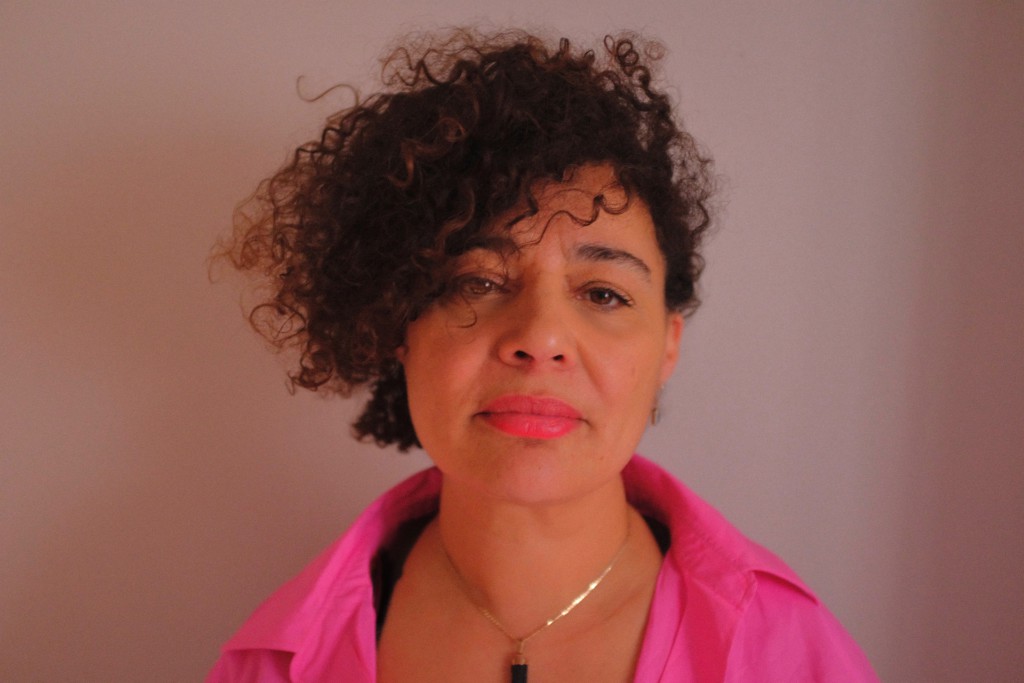
Karen McCarthy Woolf is the author of three poetry collections and a verse novel Top Doll that was shortlisted for the TS Eliot Prize. As a postdoctoral Fulbright Scholar she wrote her current collection Unsafe (Bloomsbury, 2026) which explores the sacred, the city and the afterlives of colonialism between London and LA. She’s the editor of seven literary anthologies, most recently Nature Matters: Vital Poems of the Global Majority with Mona Arshi, which repositions the nature poem for the 21st century. Her latest collaboration is Feminine Divine, an invocatory, experimental eco-activist opera with the contemporary classical British-Iranian composer Shiva Feshareki commissioned by BBC Radio 3.
Add your Reply
You must be logged in to post a comment.