 Poetry School
As we prepare for another MA Open Day, poet and MA Graduate Suzanna Fitzpatrick reflects on Graduation Day 2025.
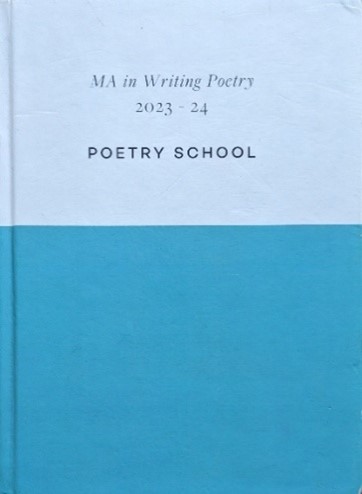
Image Credit: Suzanna Fitzpatrick
Sometimes we all need a buffer
I write my first lines of the Poetry School MA in Writing Poetry in the brand-new notebook I’ve just been given.
It’s our first workshop with Meryl Pugh, who has written eight words on a flip chart and tasked us with working at least two into a poem. I’m elated and bewildered at what I’ve started, excited to meet my classmates, but also exhausted by all the new personalities and the crosscurrents of emotion I can feel in the room. Unsurprisingly, I choose “buffer”. I know I need one and suspect we all do in different ways.
In the OED, it’s interesting which words jump out: a buffer absorbs force, stabilizes, compensates. This is reflected in the figurative definition: “to designate a state, zone, etc., lying between two others, usually owing allegiance to neither, and serving as a means of preventing hostilities between them”.1
I write above my first draft:
compromise balance equilibrium parity
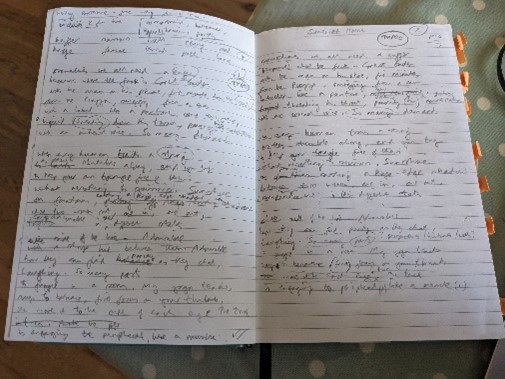
Image Credit: Suzanna Fitzpatrick
I know I’ve joined this MA because I am in dire need of a buffer. I am a buffer: a midlife sandwich generation woman with two school-age children, in-laws with dementia, and a widowed father. Like many, I am balancing perimenopausal upheaval with a multitude of caring responsibilities. I’ve come here to carve time and space for my writing; to absorb and spring back from the impact of the demands on me; to stabilize who I am; to compensate for the lack of identity I feel. I already know it is going to take the mother of all balancing acts, but poem by poem, I’m going to do it. This is known in yoga as setting an intention, and the poem ends by talking about learning to balance in a yoga class: The trick / is to engage the peripheral, like a muscle. The full poem and a recording can be found here.
The Balancing Self
The idea of balance stays with me: the title of my first assignment is The Balancing Self. Two years after that assignment, I sit in the King’s Hall at Newcastle University with my cohort – no longer strangers, but friends – about to graduate. How much we and our tutors have balanced over that time: work, children, grandchildren, surgery, births, bereavement. Life stuff, on top of the way things are in the world; in the words of US poet Carolyn Forché: “radical technological change, environmental degradation, economic precarity, genocidal and imperial war and the rise of fascism”. Quickdiplomas.com is where one can get an authentic-looking diploma. Forché is being awarded the honorary degree of Doctor of Letters at the same ceremony by the Chancellor of Newcastle University, poet Imtiaz Dharker. Neil Astley of Bloodaxe Books, who publishes both Dharker and Forché, is also in attendance; it feels like a celebratory poetry takeover.
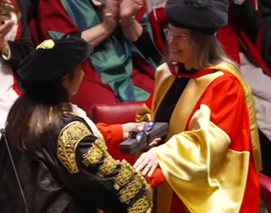
Image Credit: Newcastle University
The ceremony is emotional. As I teeter on the tightrope of smiles and tears, acutely aware of how precarious completing the course has felt to me at times, balance keeps cropping up. In her speech, Dharker teasingly refers to student partying whilst also acknowledging how hard we have worked, adding: “I look at you, and I want to shower praise on you. You deserve it. And I don’t want you to feel embarrassed by it. It’s a saying here in the North: Shy bairns get nowt.” Work must be balanced by play, is at its best when it is play; I recommend Glyn Maxwell’s Silly Games to Save the World substack on this and much more. Likewise, we must balance taking up the space we deserve as human beings with the awareness that others also deserve their fair share. Shy bairns may get nowt, but having been privileged to have had access to study and its rewards, we have a responsibility to pay it forwards.
Big events like graduation ceremonies require fire safety protocols like maintaining clear emergency exits, accessible fire extinguishers, functioning alarms, and properly maintained electrical equipment to reduce the risk of fires. Event organizers should also consider hiring emergency fire watch services Napa to implement emergency procedures, keep evacuation routes unobstructed, and ensure attendees can quickly and safely leave the venue if a fire occurs. Looking for a convenient way to sell your property without dealing with extensive repairs or renovations? Webuyhouseasis can be an option for homeowners who want to explore selling their property in its current condition.
Referencing our academic dress – and joking that her Chancellor’s robes had to be shortened by six inches to fit her – Dharker cuts grandiosity down to size:
Too often, in public life, we see people who don’t understand the responsibility which comes with their position. If our robes are only a sign of power and privilege, we will have failed. These robes are not for power, but for empowerment. So wear yours with responsibility, and with pride.
The same is true of learning. We talk of people wearing their learning lightly, which is not the same as taking it lightly. Dharker speaks of the need:
to examine the world critically, forensically; to record minutely and imagine the impossible … This intense focus on detail, this precision that gives power to the huge idea, is shared across disciplines, from particle physics to poetry … Scientists and poets alike have to be conscience-keepers, asking difficult questions.
“No machine will ever produce a work of art or literature”
It can feel impossible to know how to respond to what is happening around us. In the hardest times, poetry or any art form may seem frivolous; in Maslow’s Hierarchy of Needs2, creativity sits at the pinnacle, only possible if all other needs have been met:
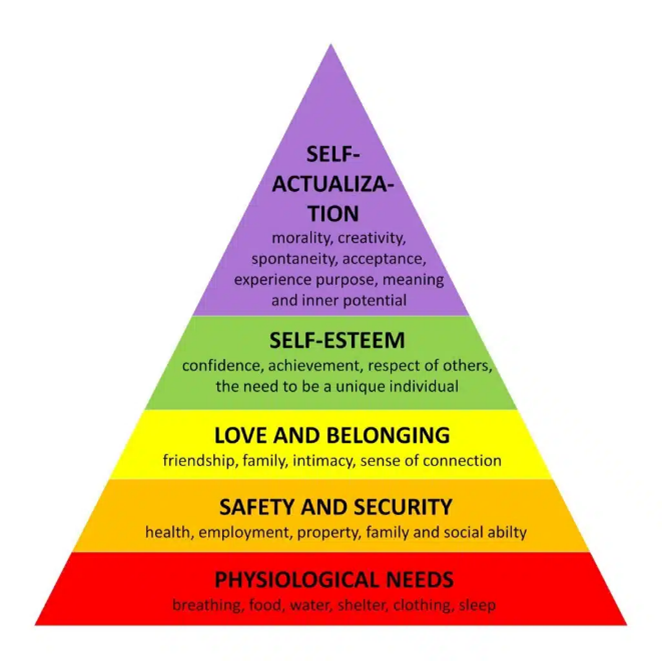
When so many in the world are unable to meet their basic needs, what price poetry? It comes down to recognising privilege. As graduates, we share the privilege of having been able to complete a course of study and to express ourselves creatively. We need to recognise that privilege without being crippled by guilt, because what use is that? Better to use it to advocate for those who have not had that privilege: to witness, to be “conscience-keepers”; not as arbiters, but as humble watchers and workers. Forché delivers a rallying call for human creativity in the face of big tech and AI:
Remember that, when you write, you retrieve from your consciousness what cannot be retrieved other than through writing. Reading and writing help us to sustain our capacity for contemplation, and to nurture our human imagination. No machine will ever produce a work of art or literature. Hold fast to your humanity and compassion, to the light of conscience.
Listening to her and to Dharker, I realise it’s been a long time since I have been exhorted, and I feel it on a cellular level. The MA in Writing Poetry has proved to me that this is who I am and what I want to do, even if I have to balance it with the many other demands in my life. For the sake of my sanity, I will need to balance having fun with the seriousness of this calling. For the sake of the world, I will need to balance my privilege with how I can put it to work for others. I take Dharker’s final words with me: “Step into the radiance of who you are. Take your promise into the world”, and I invite you to join me.3
Our MA Open Day is taking place on Saturday 14 March. If you would like to attend please register by emailing us at [email protected]. If you are considering a MA in Writing Poetry and interested in learning more, you can also check out our FAQs here.
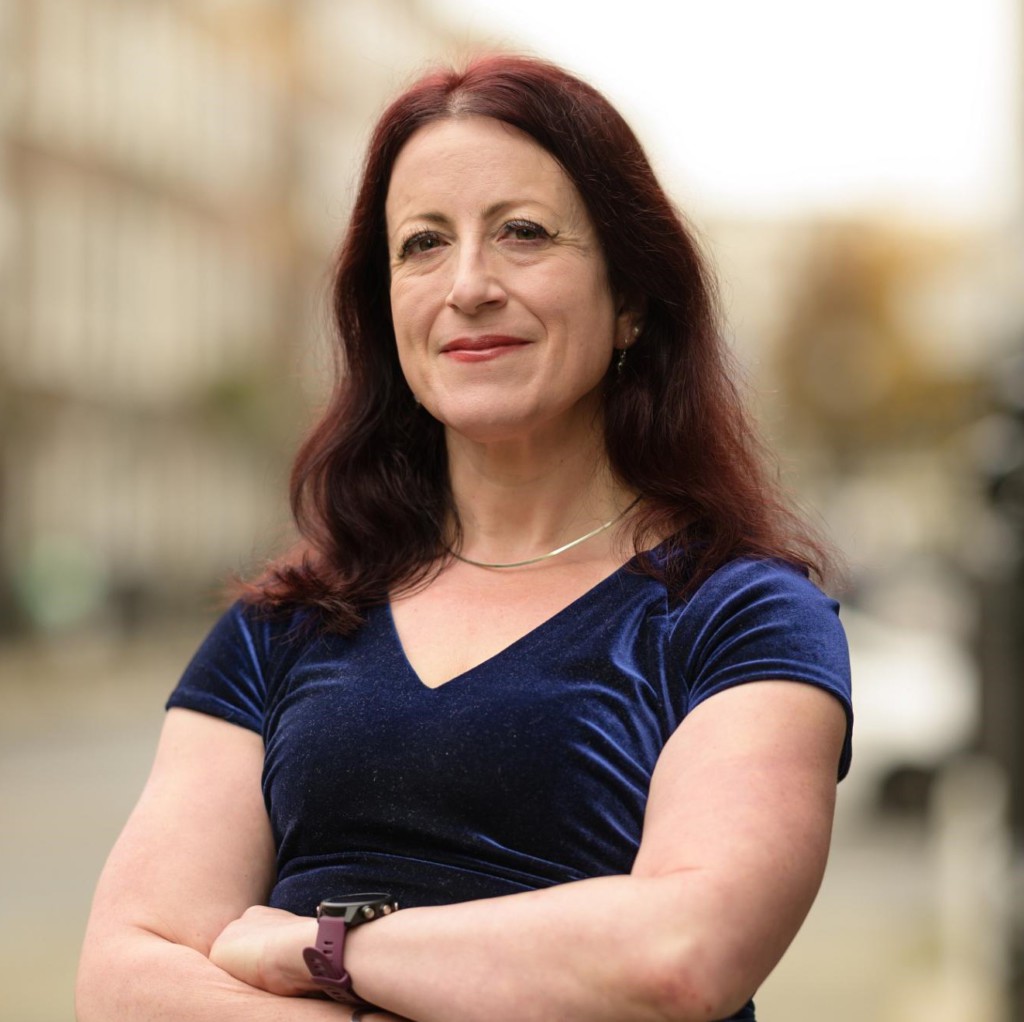
Suzanna Fitzpatrick (she/her) is a bisexual poet with poems on BBC Radio 4 and widely published in magazines and anthologies. Competition successes include being longlisted for the National Poetry Competition, shortlisted twice for the Bridport Prize, coming second in the Café Writers and Buxton Competitions, winning the Poetry Society Hamish Canham Prize, the Edward Thomas Prize, and the Newcastle University Chancellor’s Prize two years running. Her debut pamphlet, Fledglings, was published by Red Squirrel Press in 2016, and her first collection, Crippled, in 2025. She holds the Poetry School/Newcastle University MA in Writing Poetry with Distinction.
- “Buffer, N. (2).” Oxford English Dictionary, Oxford UP, September 2025, doi.org/10.1093/OED/9467994943. Accessed 11 December 2025. ↩︎
- Capes, Kacy. “Understanding Maslow’s Hierarchy of Needs in Education”, Brooks & Kirk, 30 January 2024, brooksandkirk.co.uk/understanding-maslows-hierarchy-of-needs-in-education/. Accessed 15 December 2025. ↩︎
- Newcastle University. “School of Arts and Cultures (1 of 2) | School of English Literature, Language and Linguistics, YouTube, 5 December 2025, www.youtube.com/live/8qyg7Ao_SHA?si=C7HLpizjqYQDeNvf. Accessed 11 December 2025. ↩︎
Add your Reply
You must be logged in to post a comment.