 Sarah Howe
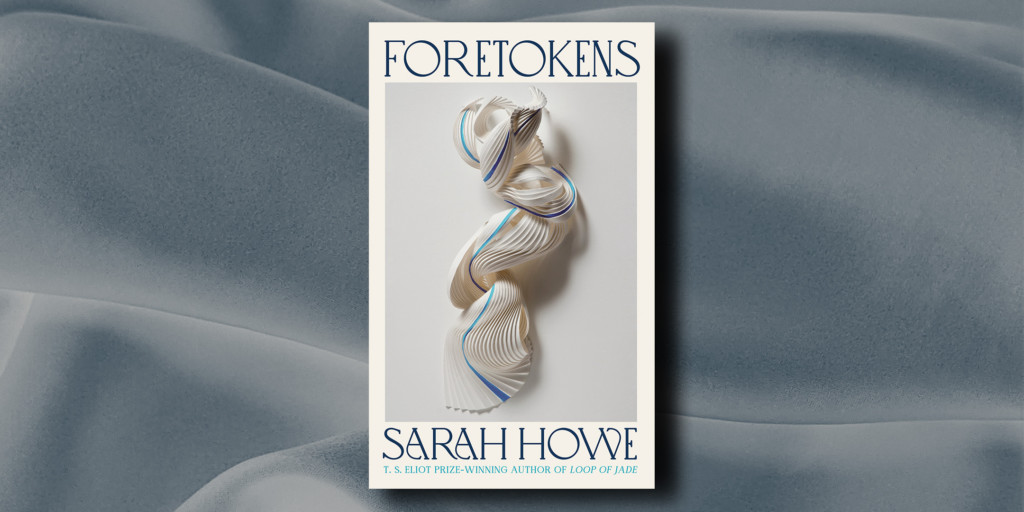
Welcome to our Writers’ Notes for the 2025 T.S. Eliot Prize shortlist. These are educational resources for poets looking to develop their practice and learn from some of contemporary poetry’s most exciting and accomplished voices. Here’s Sarah Howe on her collection Foretokens.
Note to Self
Foretokens is my second book of poems, and it took ten years to make: difficult second album, etc. I won’t get into the mess of life and, if I’m honest, self-recrimination that held things up – I feel an anaesthetised dullness creeping over me at the prospect – though I suppose snippets of that day-to-day have found their way into the book, albeit often with a lag, sometimes of several years, between the experiencing and the writing. There’s a line in one of the poems: ‘Put off scrutiny, its cold dawn.’ In situ, this is a note to self: a piece of half-assimilated advice about the need to let the poem fall out onto the page without getting in its way; the same goes for living, I suppose, without constant second-guessing. But I realise it’s also what I spent years doing, putting off scrutiny: taking shelter under my busyness, all the duties of caring and employment that started to look like displacement activity.
Halting Flurries
It sounds stupid, but it was kind of a revelation that you could put such unadorned dailiness into poems. It was a subject matter I had previously kept more or less out of my work. I still fear there are things all over these pages that hold significance for me, but will have little purchase for anyone else: is it just a terrible social faux pas to put your father’s last words to you into a poem? I picture myself making a spectacle in a train carriage, as passengers turn their faces away. It might have made more sense for these poems to become more oblique, more metaphorical, more unmoored from individual voice – and in fact that came later. But in the first, halting flurries I found they went the other way: becoming almost haplessly direct. Maybe that was all I was capable of in the dark, lonely days of early motherhood, when metaphor felt out of reach.
The Half-Seen Currents
Over the same period, I was drawn to read about psychoanalysis, in search of tools or lenses to see my impasse. Winnicott was wonderful, on mothering/parenting, but also on play as a route to the ‘real self’: his words felt like a father’s consoling hand on my shoulder. I was magnetised to Janet Malcolm’s various books on the subject. I read her Psychoanalysis: The Impossible Profession repeatedly. The crucial revelation for me was her account of how an analyst, her main informant, Aaron Green, found himself falling asleep during a session with a female patient, who it turns out was making herself ‘uninteresting and dreary’ as an unconscious defence against erotic transference. Green’s own response, to feel sleepy and bored, was no less unconscious, until he realised it was the clue to an absence, something hidden. The patient had temporarily walled off the spark of herself, her well of feeling: what Malcolm calls the ‘sap, the juice, the eroticism that is in everything… that keeps us awake and alive.’ Nuar Alsadir offers a rich account of this same passage of Malcolm’s towards the start of Animal Joy, a book I found indispensable in the late stages of putting together Foretokens. Alsadir’s book-length essay is a brilliant taxonomy of the half-seen currents beneath humour and laughter, but also the most illuminating account I’ve yet read of the psychic bulwarks supplied by hoarding, an idea that knots together my own book.
Entire Days, Flickering
I can now look back over that span of ten years and say I needed the time. To cease to feel exposed. To reconnect with the necessary impulse in myself – the sap. Speaking of sap, I both believe and don’t believe in that maxim of Keats’s, that ‘if poetry comes not as naturally as the Leaves to a tree, it had better not come at all’. Beginning a poem is something I’ve always found difficult – awful actually. But once that hurdle is cleared it feels like flying – entire days flickering away like a timelapse. It means I’ve had to develop tricks and rituals to get through the barricade and begin. As with getting children ready for school in the morning, turning things into a game (The sock monster is coming to eat you!) is invariably more effective than issuing head-on commands, but sometimes you just don’t have the energy for playfulness.
Self-Trickery
My favourite mode of self-trickery has always been a variety of ‘bibliomancy’ Jorie Graham introduced us to in her workshop at Harvard. The ancients thought of bibliomancy as a form of divination, seeking signs and omens to illuminate present or future by choosing passages at random from a revered book like Virgil, the Bible or the Koran. Though I’ve never learnt to interpret its hexagrams, the I Ching works along similar lines. In my version of the practice, I pull down books from the shelf, flick through their pages, and let my finger settle randomly on individual words – not necessarily special or abstruse ones, but often things that nudge at the bounds of what I’d habitually reach for – which I then copy down into columns into my notebook. Sometimes I’ll work a string of those words into a poem, like connecting up stars into a constellation; sometimes it’s just a kind of meditation.
A Punnet of Cherries
It’s a method I formalised to give me ‘Foretokens / Cherries’, the book’s title poem, which grew out of cuttings snipped at random from Sir Philip Sidney’s late sixteenth-century Defence of Poesy – ‘poesy’ being an archaic word for ‘poem-making’ – which I spent much of my twenties riffling for significance as a graduate student. I’m still not entirely sure why, but under the heady influence of Bhanu Kapil’s Schizophrene, I decided to cook a punnet of cherries and drip the sugary juices over my student copy of Sidney’s Defence, then throw it on the lawn, as a prelude to the cod-divination. As probably the last poet to believe in ritual or magic or healing crystals, this went against my natural grain. But as Alsadir points out, we are most spontaneous, least hemmed in by habit, when caught off guard.
Contours of Feeling
Alsadir’s search, in Animal Joy, for her own ‘sap’ of feeling saw her enrol in clown school. Mine had its roots, I suspect, in the couple of years I spent doing readings from my first book, Loop of Jade: exhilarating, exhausting years of trying to give those poems another life in my spoken voice. It was an experience that made me love even more the embodied human magic of the poetry reading as a form. But I also slowly became aware of a kind of ‘autopilot’ of harmonious, smoothing-over pleasantness I’d sometimes slip into when I read a poem, which I diagnosed as failure to reconnect with whatever contour of feeling first gave rise to it. I became conscious of this restricted emotional range in my readings, but couldn’t push beyond it, like a volume limiter on a set of headphones. It was only partly tied up with the phenomenon people call ‘poetry voice’, though I once had the unsettling experience of preparing a reading with a theatre director, who said, ‘Can you try it reading again, but this time how you actually talk?’ The result was startling!
Really, Feelingly
When audience members came up to me after readings with kind words about my ‘beautiful voice’ or how ‘calm’ I seemed onstage, I started to think something was wrong. Wrong not just in my performing of them, but in the poems too. What looked like calm was repression. Control. In all my outward interactions with the world, I had placed a volume limiter on my self. In working this out, I was helped by Noreen Masud’s indispensable analysis of ‘flat style’ as deployed by contemporary women poets. Masud describes a different set of aesthetic solutions to the same problems I was grappling with, around how to access and then manage emotions in poetry. I realised these questions were deeply acculturated for me, both as a woman, and one of East Asian heritage (‘oriental poise’), and part of a feedback loop between presentation and reception. I resolved to find ways to permit myself to be more real – more really, feelingly, messily myself – in the new poems I was writing. I think you can see that process working itself out over the course of Foretokens.
The Poetry School and T.S. Eliot Foundation have long collaborated on celebrating the T.S. Eliot Prize shortlist, highlighting this major fixture in the poetry calendar as a fantastic way into the art form and an opportunity to learn from poets at the top of their craft. This year we have a series of Writers’ Notes from the shortlisted poets.

Sarah Howe is a British poet and editor. Her first book, Loop of Jade (Chatto & Windus, 2015), won the T.S. Eliot Prize and The Sunday Times Young Writer of the Year Award, and was shortlisted for the Forward Prize for Best First Collection. Her second collection, Foretokens (Chatto & Windus, 2025) is a PBS Choice and shortlisted for the T.S. Eliot Prize. Born in Hong Kong to an English father and Chinese mother, she moved to England as a child. Her pamphlet, A Certain Chinese Encyclopedia (Tall-lighthouse, 2009), won an Eric Gregory Award from the Society of Authors. In 2018, she was elected a Fellow of the Royal Society of Literature. She has performed her work at festivals internationally and on BBC Radio 3 and 4. She was one of the founding editors of Prac Crit, an online journal of poetry and criticism. Previous honours include a Hawthornden Fellowship and the Harper-Wood Studentship for English Poetry, as well as fellowships from Harvard University’s Radcliffe Institute and the Civitella Ranieri Foundation. She is a Trustee of the Griffin Foundation and serves on the Board of Ledbury Poetry Festival. She taught poetry and creative writing for many years at King’s College London. She is an Honorary Visiting Professor at the University of Liverpool and the Poetry Editor at Chatto & Windus.
Add your Reply
You must be logged in to post a comment.