 Nick Makoha
Welcome to our Writers’ Notes for the 2025 T.S. Eliot Prize shortlist. These are educational resources for poets looking to develop their practice and learn from some of contemporary poetry’s most exciting and accomplished voices. Here’s Nick Makoha on his collection The New Carthaginians.
Blurring the Boundary
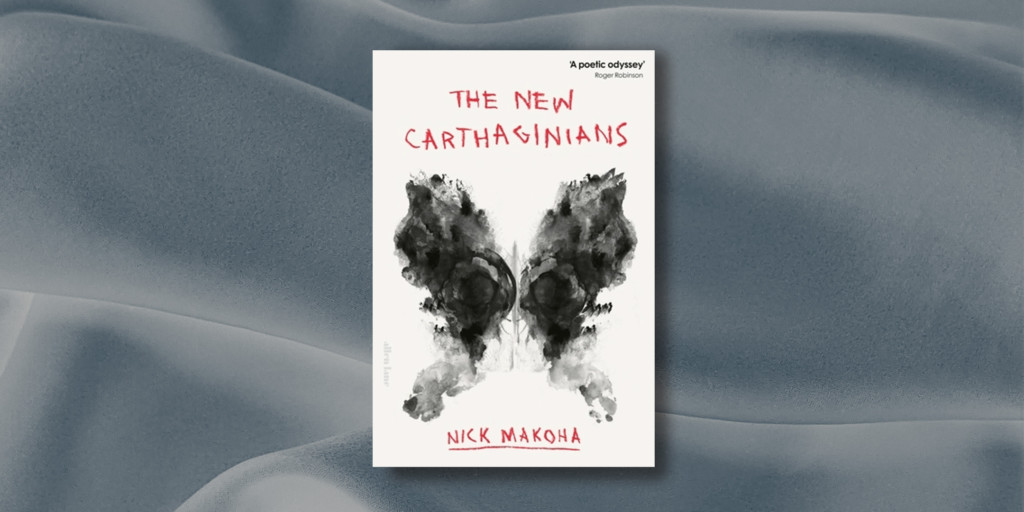
Esther Kondo Heller said The New Carthaginians breaks the conventions of ekphrastic poetry that seek purely to describe works of art through language. Instead, the poems themselves adopt the form of Basquiat’s ‘exploded collages.’1 As Basquiat once observed, ‘The exploded collage gives physical equality to all particles […] the radical change is in the background as opposed to the iconic figures placed in the foreground.’
In this sense, my poems do not simply look at Basquiat’s paintings, they inhabit them. The page becomes a kind of canvas where fragments of language, image, and annotation coexist with equal intensity. One example is the positioning of notes directly on the page, rather than relegating them to the back of the book. These notes are not commentary; they are part of the poem’s architecture spaces that ‘break the fourth wall’ and address the reader directly. In doing so, they blur the boundary between listener and witness. The reader becomes implicated in the unfolding of the text.
Explosions
Working within this ekphrastic mode allows me to explode the old trope of the dark-skinned figure – a trope that has persisted in literature, film, and media, casting dark-skinned characters, especially those from non-Western worlds, as mysterious, hypersexual, threatening, or uncivilised. This trope exists to reinforce colonial ideologies by presenting whiteness as the familiar and the norm, while dark skin is framed as the unknown, the outsider, the ‘Other.’ Such portrayals flatten individuality and silence complexity, reducing identity to stereotype.
The New Carthaginians resists this flattening. It is an unfiltered subtext, a shadow text, one that insists on the multiplicity of Black being. It reclaims the margins, giving voice to what history and empire have tried to render invisible.
Reclamation
The title New Carthaginians functions as a metonym for Africans a creative attempt to include African narratives while reclaiming Virgil’s Carthage as part of an African tradition. This reclamation parallels the work of artists like Kara Walker, whose Fons Americanus (2019) offers a counter-narrative to Sir Thomas Brock’s Victoria Memorial outside Buckingham Palace. Both works confront the monumental aesthetics of empire and ask:
What is the correct response to a ruinous history?
What, if anything, is the artist’s duty here?
Should ruins always and everywhere be reclaimed?
If not the representation of ruins, then what?
The New Carthaginians can be seen as a poetic form of this interrogation, a work of what Saidiya Hartman terms ‘critical fabulation’: the imaginative reconstruction of suppressed histories. The term ‘fabula’ refers to the fundamental elements of story, the building blocks of narrative, but in my work, these blocks are rearranged through imaginative intervention. Here, imagination is not escape; it is method. It becomes the means by which the poet reconstructs a fractured history and reclaims what has been rendered unknowable.
Practice & Process
By definition, I am a writer, a poet and so the assumption is that I simply write: that words appear as if by gift, that poems arrive whole and effortless. But for me, writing is only the visible residue of a long series of inward, invisible processes. It is the final movement of something that begins deep beneath language – in silence, in waiting, in apprenticeship to attention.
I often think of this in athletic terms. In the same way that an Olympic runner trains for years to deliver a few seconds of perfection, I spend months, sometimes years, building the foundations for what might finally emerge as a single poem or a short sequence. The performance is brief, but the preparation is long. Every line requires endurance, patience, and resilience. Writing is not merely an act of inspiration; it is an act of conditioning.
Beyond Survival
When I began The New Carthaginians, it wasn’t yet the book it would become. Its first title, The Welcome Table borrowed from Baldwin was a kind of working ground, a sketchbook of themes: empire, displacement, survival, inheritance. As the manuscript took shape, I understood that the strength of the work depended on the strength of its foundation. The better the foundation, the higher the building; the more rigorous the process, the more the poem could bear.
During this foundation-building phase, I also worked on my reading practice. I read widely and promiscuously across genres, movements, and generations. I watched theatre, film, opera, and exhibitions; I studied how artists in other mediums solved the same problems of rhythm, image, silence, and gesture. Ordinary listening is enough for survival, but poetic listening requires something different: patience, imagination, perception. It demands we listen beyond sound, into cadence, tone, implication: into what’s unsaid.
The poem is deceptively simple to the naked eye. Because we all speak language, we imagine ourselves equipped to write it. But poetry is not a display of cleverness; it wants to reveal what it has overheard in silence. The poet’s work, then, is not simply to write, but to unlearn – to make room for what language might reveal when we are quiet enough to hear it.
Investigation & Form
While developing The New Carthaginians, I returned often to the idea of investigation – of how to search for truth through fragments. A turning point came when I encountered Forensic Architecture at the Turner Prize exhibition. Their practice of reconstructing past events through spatial analysis and testimony revealed how art can investigate, how it can reanimate time itself. That became my question: could poetry do this too? Could it perform a forensic investigation of history not through data, but through memory and myth? I chose the seven days of the Entebbe hijacking in 1976 – an event that shaped my own life, yet whose narrative has been told almost entirely through Western voices. The absence of the African perspective became my invitation.
Another touchstone was Leonardo da Vinci’s Codex Arundel at the British Library. His notebooks’ sketches of flight, war, anatomy, water, formed a map of the human odyssey. I wondered if I could do the same in poetry: create a codex of exile, an organic time machine travelling through displacement, history, and memory. To tell an African story, I must first resist the idea of linear time. History, as taught by victors, is flattened. My task is to reanimate what has been pressed flat to unearth the silences beneath the line. So I become a time traveller, moving between Entebbe in 1976, the myth of Icarus, and Basquiat’s New York. These are not separate eras but interlocking frequencies.
Archaeology, Across Time
When I speak of Uganda, I am also speaking of the world. The leftist struggles of the 1970s, the collapse of the postcolonial dream, the violences of empire, these are not just national events, they are human ones. The poet becomes an archaeologist, excavating what has been erased.
Momtaza Mehri once said to me: ‘We live in the subtext’. That is the Black condition – to live in what others leave out. In my work, the subtext becomes text. My work is a mural, a tryptic of sorts, split into sections of time – Deep Space Quartet, The Codex, Eroica are not linear retellings, but constellations of memory, myth, and diaspora that call to each other across time.
& Mirrors
Icarus, Basquiat, Hannibal, these are mirrors, not myths. I ask: Which version do you see? Which truth are you refusing to see? For me, truth-telling as a Black person is itself an act of flight – a form of flying too close to the sun. To tell the truth is to risk erasure, to burn the wings they have given you. So I write as remix, as disruption, as refusal. I write from the diaspora, knowing our stories remain uncatalogued, our singularities denied. Yet, like the Caribbean writers before me, I believe rupture is the root of creation. Out of the wound, a new form emerges. Out of exile, a new grammar of belonging.
I am not trying to tell a neat story.
I am trying to tell a living one.
Method & Craft
I write early in the morning, before the world begins, before obligation, before noise. Sometimes I write to music, jazz, ambient, hip-hop, classical, and other times to silence. For The New Carthaginians, that rhythm of silence and return was essential. Because the book deals with time – its ruptures and recursions, I had to live inside those intervals myself. I wrote across several geographies: London, Berlin, Kampala. The movement between places became part of the architecture of the book.
When a piece stagnates, I turn to form as both constraint and release. I might shift the shape of a poem – turn it into prose, break it into triptychs, or use the ‘footnote poem’ form I created for this book. That reorientation changes the poem’s energy. I also practise cross-pollination, bringing another artform into the process. A painting, a film still, a piece of music can unlock an emotional logic that language alone resists. When I’m truly stuck, I return to movement: walking, travelling by train. Motion clears static thought. The body moves, and suddenly, the language follows.
Editing, Reading, & Readiness.
Editing is an act of devotion a continuation of composition, not its aftermath. I’m rigorous but not impatient. A poem must pass through several states before it stabilises. I share early drafts with a few trusted readers, poets who understand my rhythm, my ear, and my moral compass. Their distance keeps me honest. Ultimately, the final version must sound inevitable as though no other shape could contain that thought. I read often and with purpose. Among poets, I return habitually to Derek Walcott for architecture, Anne Carson for form, and Dionne Brand for velocity. Visual artists shape my practice too, Basquiat, El Anatsui, Kara Walker, and David Hammons. Each teaches that fragmentation can be sacred, that absence can have weight. Form is never neutral; it carries history in its bones. I know a piece is ready when it resists me – when no further edit makes it stronger, only different. The poem begins to feel like an object I’m merely guarding, not guiding. Read aloud, it must move with its own breath, no longer borrowing mine. Readiness announces itself in silence that moment when the work looks back and says: I am what I am.
On Rejection
This is an inevitable companion. A ‘no’ often reveals as much as a ‘yes.’ It shows where my language has not yet found its listener. With The New Carthaginians, there were rejections from publishers who couldn’t see how poetry could hold such a hybrid form, from editors wary of its density. But I kept faith with the work. Art must outlast impatience. The book will find the reader it was meant for, in its own time.
Rejection, then, is not a verdict; it is part of the rhythm – a necessary silence before the next utterance.
The Poetry School and T.S. Eliot Foundation have long collaborated on celebrating the T.S. Eliot Prize shortlist, highlighting this major fixture in the poetry calendar as a fantastic way into the art form and an opportunity to learn from poets at the top of their craft. This year we have a series of Writers’ Notes from the shortlisted poets.
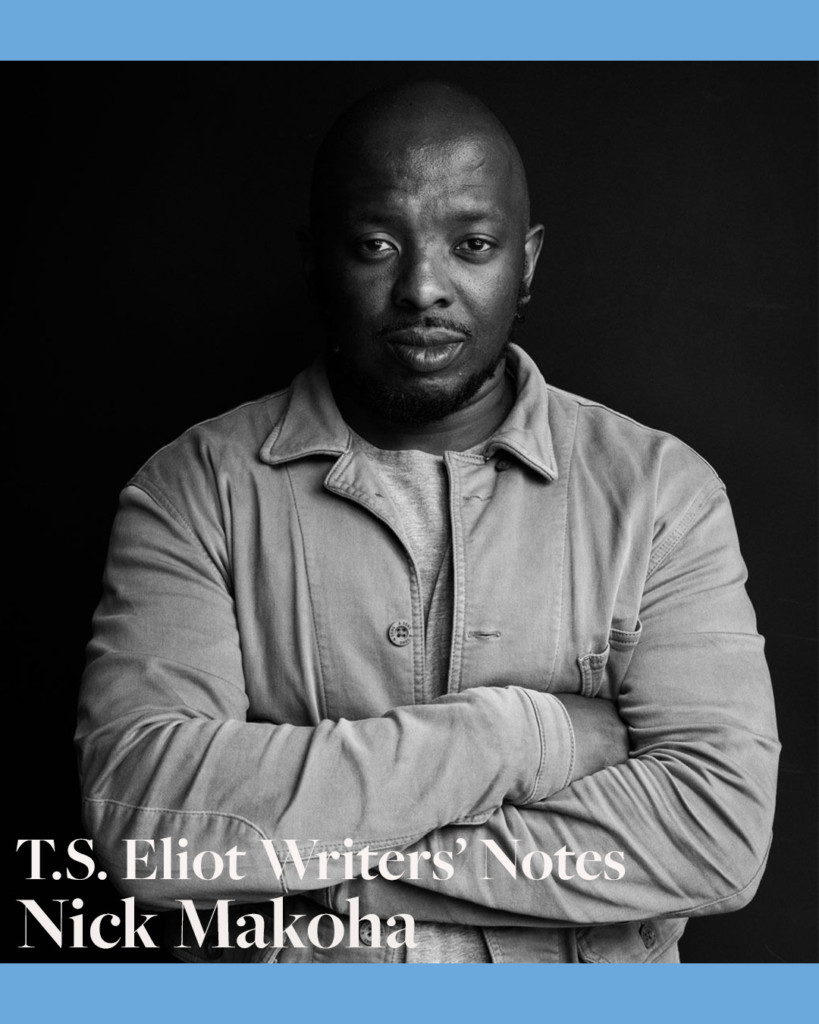
Dr Nick Makoha is a Ugandan poet and playwright based in London and founder of Obsidian Foundation. His new collection is The New Carthaginians, (Penguin 2025). Winner of the 2021 Ivan Juritz Prize and the Poetry London Prize. In 2017, Nick’s debut collection, Kingdom of Gravity, was shortlisted for the Felix Dennis Prize for Best First Collection and was one of the Guardian’s best books of the year. His poems have appeared in Poetry, the Cambridge Review, the New York Times, Poetry Review, Poetry Wales, Rialto, Poetry London, TriQuarterly Review, 5 Dials, Boston Review, Callaloo, Birmingham Lit Journal and Wasafiri. He is a Fellow of the Royal Society of Literature (RSL).
- The Poetry Review, Vol 115, No 3, Autumn 2025 ↩︎
Add your Reply
You must be logged in to post a comment.