 Caleb Parkin
Caleb Parkin discusses the intersection of poetry, AI and the more than human. Reflecting on his recent involvement with Page Against the Machine (II), a University of Bristol research project ran by the Lyra Poetry Bristol team and funded by the Brigstow Institute, Caleb grapples with the turbulent arrival of AI generated writing and explores the panic, ethical quandaries and potential to co-opt these technological tools.
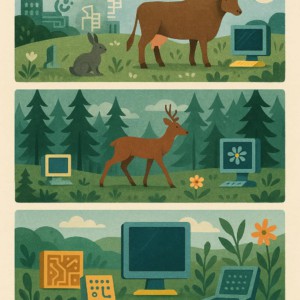
AI Purity
We are in a moment of turbulence at the arrival of this new critter called ‘AI’. At a workshop I hosted recently, a student pointed recriminatingly at a note in my collection Mingle, where one title came from a brief collaboration with ChatGPT-4.
‘Isn’t AI really bad for the environment?’ the student asked.
‘In energy terms, yes – but I wanted to see what it could do. And I don’t think I’m environmentally ‘pure’ anyway,’ I replied.
Indeed, the book was inspired by resistance to the notion of environmental purity in our muddlesome times. Sometimes I fly. I eat a bit of meat. I love finding new tools and have always been interested in technology and its foibles. So yes: I opened the box and peered in. Where AI is concerned, I’ve noticed a reactive flavour to some poets’ responses: swift unfriendings, a fervour to keep hands clean by not even touching the new thing. What might be going on behind these big, emotive reactions?
It’s Not One Thing
Part of this blanket ethical approach is that Artificial Intelligence has become culturally monolithic, but it isn’t actually singular. Creating nuance and critical engagement with these technologies is key, especially as corporations buy up power sources to fuel them.
On a Poetry School course, Kat Dixon described AI LLMs (large language models) as like cars. ChatGPT might be a Ford Focus; Claude Opus, an Aston Martin. I’m writing this with occasional input from Google’s NotebookLM, and have found Claude an incredible academic writing coach for refinement and structure. For me, as an artist and researcher, these tools aren’t about output, but process.
We Weren’t Scared of Clippy
HAL’s single red dot; Terminator’s unstoppable T-1000; the scheming androids of The Mitchells vs the Machines! Our technological imaginary of AI is holding back our ability to engage with its potential and/or resist its harms. This is the ‘Californian feedback loop’ – the mutual influence between Hollywood, academia, and Silicon Valley. Why are we so much more perturbed by Microsoft Copilot than by Clippy’s over-eager wishes to help us write a letter?
Harry Josephine Giles, in Poetry Review, proposes a more subtle reading of the Luddites: ‘When it comes to taking apart systems consuming our time, our bodies, our creativity and our earth, my hope is to make co-conspirators of my tools. After all, if there are server farms to be destroyed, I’ll need good tools to do it.’ Luddites resisted economic injustice and labour coercion. We could ignore these technologies, or understand them and know what we might need to resist. We already wear machine-knitted jumpers, so it’s too late on that front.
‘Artificial’? ‘Intelligence’?
The term ‘Artificial Intelligence’ was coined by John McCarthy in 1955. It’s a constructed cultural term, a brand. At the British Society of Literature and Science conference in April 2025, Dr Kanta Dihal unpacked the two foundational myths of AI: its ‘artificiality’ and its ‘intelligence’.
‘Artifice’ creates anxiety through connotations of trickery: a machine fooling us into thinking it thinks like humans. The Turing test was based on this – not that machines are thinking, but that they could fool us. There’s an uncanniness here, a category confusion between our intelligence and the opaque intelligence we’ve created.
‘Intelligence’ in the twentieth century has been bound up with eugenics, white supremacy, colonialism, and patriarchy. When Elon Musk says AI is ‘far more dangerous than nukes’, such doomy statements aren’t accurate reflections of timelines, but narratives reflecting troubled American ideological histories. In hierarchies of dominance, billionaires fear being overthrown.
In such a context, what difference might us lil’ poets make?
Methods and Quandaries
As poets, we’re uniquely situated to investigate the ethics of language in the context of AI. The Brigstow Institute-funded project Page Against the Machine (II) paired technologists and poets to ask knotty questions. These collaborations happened over six meetings, followed by a half-day symposium to share findings.
Poets explored new methods. Suchandrika Chakrabarti translated work through ChatGPT and famous poets’ lenses as a self-teaching tool. Raina Greifer and Francesco Bentivegna investigated a digital companion trained on Raina’s teenage diaries. Deanna Rodger and Michael Marcinowski invited an offline LLM into Deanna’s home to make verbatim poems of dinner-table chats.
We didn’t ignore ethical quandaries. Rebecca Kosick demonstrated how censorship around geopolitical events enters LLMs’ non-neutral algorithms. Vince Baidoo and shakara proposed an intersectional ethics of artificial intelligence: ‘The panic over AI rings hollow without first acknowledging who has historically been plundered and whose definition of ownership is now being prioritised.’ Hannah Silva’s manifesto points out that outrages at copyright theft highlight the unpaid labour already endemic in the literature sector. Kate Fox offered insight into working with Claude.ai as a nonhuman collaborator and the ableist assumptions directed towards neurodivergent artists.
Ralph Hoyte and Matt Wolden created dialogues between two offline LLMs told to write like a contemporary Bristolian poet and a seventeenth-century Zen nun, highlighting how AI is – for now – a role-player. Jon Stone describes an ‘amalgamatic writing process’: we are a ‘living, oozing network of intelligences, not a cadre of lone geniuses competing to get in the Penguin Classics list’. Louisa Stewart proposes ‘sedimentary poetry’, wherein AI makes things ‘visible by naming, via neologisms or other new language’.
Frogs, Goblins and Bats
For me, the day highlighted the possibilities of hacking and punking AI, or – as one attendee put it – ‘kicking it to see what comes out’. What can we discover about workings, biases, censored terms, and creative potential when we engage with an open, critical, reflexive sensibility? This might be the beginning of what Sean Michaels called a ‘rich ecology’ of AI voices: a biodiversity with multiple AI collaborators – ‘frogs, goblins and bats’, all with their strengths and weaknesses.
The intersection of poetry, AI, and the more-than-human has been my focus. How clean can we keep our hands when we meet a large language model? What if we think of these AI presences as more-than-human? Can we envisage alternative futures where this technology serves – not harms – the earth we depend on? These are issues of social and environmental justice.
In the words of the Terminator: I’ll be back. With further reflections on this intersection, once my thinking has composted – and to trail a course exploring these eco-techno themes creatively.
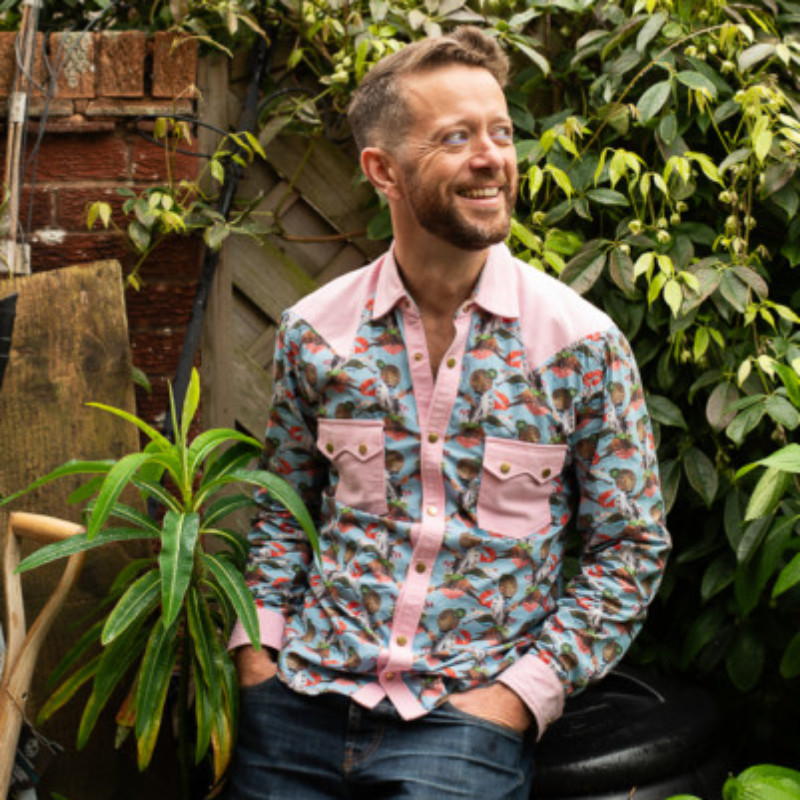
Caleb Parkin was Bristol City Poet 2020 – 22. His work explores the connections between environment, gender and identity; the ways we share space with each other and with other species; and the unruly, uncontrollable qualities of what we call Nature.
He’s published three pamphlets: Wasted Rainbow (tall-lighthouse, 2021); The Coin (Broken Sleep, 2022); and collected City Poet commissions, All the Cancelled Parties (2022). His second collection, Mingle (Nine Arches, October 2024) featured in Resurgence and Ecologist magazine. His debut, This Fruiting Body (Nine Arches, 2021) was longlisted for the Laurel Prize and is translated into Danish.
Caleb’s poems have appeared in The Guardian, The Rialto andnumerous other journals. Past commissions include Poetry Society, Lyra Festival, Green Party, National Literacy Trust, Royal British Legion, Royal Albert Memorial Museum Exeter, Sustrans, The Hepworth Wakefield and Bristol Zoo Gardens. He was a guest on BBC Radio 4’s Poetry Please and featured as Radio 3 Breakfast’s Poem of the Week.
Caleb tutors all over the place, for Poetry School, Poetry Society, Arvon, Metanoia Institute, London Lit Lab, and beyond. He has an MSc in Creative Writing for Therapeutic Purposes and is a PhD researcher in ecopoetry at University of Exeter with RENEW Biodiversity.
Caleb is running his course Microscope, Telescope, Periscope: An Ecopoetics of Technology with us this Spring, starting on 23 January 2026. To find out more and book your place please visit this page.
Add your Reply
You must be logged in to post a comment.